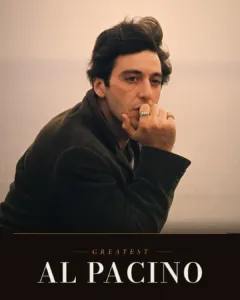
 At five, Al Pacino’s most popular role was a drunk. The stage was the living-room floor of his grandparents’ apartment, and the audience was his relatives. They laughed until they cried, though the scene the boy was performing was no comedy.
He had lifted the scene from a movie. His mother, Rose, had been taking him to the pictures since he was three or four, whether or not the film was fit for a child. Billy Wilder’s The Lost Weekend, released at the end of 1945, he watched sitting beside her. In it Ray Milland plays a failed writer who stays off the bottle for ten days and then goes under again. Off the drink now, Milland cannot remember where he hid his bottles while he was drunk, and he tears his apartment apart looking for them. The scene lodged itself in Pacino’s head.
Whenever the relatives gathered at his grandparents’ place, he was called up to do Milland’s search one more time. As desperately as Milland had searched, the boy searched just as desperately in the middle of the room. The room roared with laughter. Little Pacino, not understanding, only wondered to himself: what are they laughing at?
On paper his name was Alfredo James Pacino. His mother called him Sonny, after Al Jolson’s song “Sonny Boy,” and at three he was already singing it back, imitating Jolson. Nearly eighty years later, in 2024, when Pacino sat down to write his memoir, he gave it that same nickname for a title, and in its very first sentence told us he has been acting since he was a little boy. Yet across much of the book, given the same tenderness as the films, are a few people who could not come all the way with him.
When Pacino was two, his parents, Salvatore and Rose, split up. His father left for California. Rose moved with her son into her parents’ apartment, the home of James and Kate Gerardi, in a poor neighborhood of the South Bronx near the zoo. Money was always tight, and Rose’s escape from those dreary days was the movie theater. Pacino writes that in the dark of the theater his mother could hide.
Rose was not an easy person. Pacino compares her to a fragile, ungovernable character out of a Tennessee Williams play. Anxiety never left her, and she kept a close eye on wherever her son went. She often forbade him to go out on the street. The teenage Pacino would burn with rage at this, yet much later he admitted that her forbidding saved his life. As far as Rose’s gaze could reach, Sonny was safe.
In the fifties, Pacino’s gang in the South Bronx was four strong. Running with him were Cliffy, Bruce and Petey. The four of them leapt from one rooftop to the next, and came down to the street to light cigarettes at the mouth of an alley. The other three spent their days stealing cars and getting high. Because of his weakness for pistachio ice cream, they called Pacino sometimes Sonny, sometimes Pistachio. The leader was Cliffy, who even at thirteen always had a Dostoevsky stuffed in the back pocket of his pants.
When it came to drugs, though, Sonny was different from the rest, and Cliffy was the first to see it. Sonny doesn’t need dope, Cliffy used to say; his high is inside his own head. The other difference was Rose. Cliffy, Bruce and Petey all died young, of heroin overdoses. Pacino writes that he made it out and they did not, and he gives the credit for his survival to his mother, who kept him away from the needle. In Sonny Boy, written at eighty-four, he goes back to those three both near the beginning and in the final pages.
His grandfather, James Gerardi, was born in a small town in Sicily and came to America as a child. He worked as a plasterer. Pacino writes that this warm, soft-hearted man became a father to a grandson who had none. A love of sports, and the habit of cheering himself hoarse for the underdog: Pacino got both from his grandfather.
One day a teacher from Pacino’s junior high school climbed the five flights of stairs to his grandparents’ apartment. Having seen the boy in a school play, she was so certain of him that she came to deliver the news to his grandmother herself. Her message was a single one: this boy has to be allowed to keep acting. Still, at seventeen Pacino had to leave the High School of Performing Arts and go to work, because a household full of worry needed money.
In 1962, Rose died at forty-three of an overdose of her medication, most likely by accident. Pacino was twenty-two. The following year James died too. Pacino later said that losing the two most influential people in his life at twenty-two sent him into a tailspin, and he has called those years the lowest point of his life. For a while he did not even have a roof over his head. Janitor, busboy, furniture mover: from jobs like these he scraped together the fees for his acting classes at the Herbert Berghof Studio.
About eight years later, Francis Ford Coppola wanted Pacino for Michael Corleone in The Godfather. Paramount did not. The studio’s list ran to Jack Nicholson, Robert Redford, Warren Beatty and Ryan O’Neal. Coppola kept fighting, and Michael became the boy from the Bronx. When the news came, Pacino phoned his grandmother Kate to tell her he was going to play Michael Corleone. On the other end of the line she said, “Sonny, listen, your grandfather was born in Corleone.” The name of Corleone, a small town about forty miles from Palermo, was the one Mario Puzo had given to the Godfather’s family. Eight years after his death, James Gerardi came back in his grandson’s first great role as a surname.
The shoot began in New York, with the wedding scene. Pacino and Diane Keaton both disliked it, so for the first few days they spent their time on set laughing together, and in the evenings went back to Manhattan to drink. Both were convinced they were working on the worst picture ever made. The studio executives, watching the day’s footage, could not work out what their leading man was doing. Word went round that Pacino would be fired, and probably the director too. Pacino later said that if Coppola had not stood by him, one day he simply would not have shown up, because he did not want to stay where nobody wanted him.
Then Coppola reshuffled the schedule and moved up the restaurant scene. There Michael, avenging the attempt on his father’s life, shoots Sollozzo and the corrupt police captain McCluskey. Shooting the scene took fifteen hours, through one April night. Coppola showed it to the studio, and Pacino stayed Michael.
Then the company went to Sicily, and there the grandson of Corleone discovered that he did not know his grandparents’ language. Speaking Italian, driving a car, dancing: he could do none of them, yet in the film the Sicilian Michael dances at his wedding and drives away with his new bride. The extras on set understood no English, and one day Coppola lost his patience and shouted, “Why did I ever hire you?” By then his grandfather’s town had become his character’s surname, and still his grandfather’s tongue would not come to his lips.
In the sixties Pacino had another job, as a messenger for Standard Oil. Doing the same work was another aspiring actor, from Massachusetts, named John Cazale. Pacino later said that the moment he first saw John, he found him fascinating. In 1968 the two went on stage together in Israel Horovitz’s The Indian Wants the Bronx, and both won Obies, the off-Broadway award. The friendship that began with that play lasted until death.
Cazale came to audition for Fredo, Michael’s middle brother in The Godfather, reportedly at Pacino’s urging. Three years later, when Sidney Lumet made Dog Day Afternoon, it was Pacino who persuaded Lumet to audition the thirty-nine-year-old Cazale for Sal, the bank robber’s accomplice. In that film Pacino himself played the robber, Sonny Wortzik, and so the name his mother had called him came back on screen, worn by another man.
Pacino called Cazale his acting partner. Their most memorable scenes together, though, are built on the breaking of two brothers. In the first Godfather, Michael tells Fredo that he is his older brother and that he loves him. In the next film, Part II, he orders that same brother killed for betrayal. It seems to me that the chill of those scenes was not Pacino’s work alone. It was because he stood opposite the wounded look Cazale held in Fredo’s eyes that Michael’s silence could grow so heavy. Pacino himself has said he learned more about acting from John than from anyone.
In March 1978, John Cazale died of lung cancer at forty-two. He made only five feature films, and all five were nominated for the Oscar for Best Picture, though he himself was never nominated once. Dog Day Afternoon was the two friends’ last work together on screen. At the fiftieth anniversary of The Godfather, in 2022, Pacino called Cazale one of the great actors of their time, and of any time.
In 2009 a documentary was made about Cazale, titled I Knew It Was You. The title comes from the line in The Godfather Part II in which Michael lets Fredo know that he knows the traitor was Fredo. What on screen had been an accusation became, as the title of a documentary, an act of recognition. Pacino, too, sat down in that film to talk about his friend.
The seventies, the very years of his work with Cazale, were not easy for Pacino either. Nothing had prepared him to handle fame, and the boy who had once acted out the hunt for a hidden bottle was now drowning in drink himself. He later said he does not remember much of that decade. It was his old teacher Charlie Laughton who pulled him out. Laughton did not tell him to stop; he only asked him to notice that he was in fact drinking. A year or so later Pacino gave it up, and he would say afterwards that Laughton’s words saved his life. Laughton died in 2013, and in the dedication of Sonny Boy his name stands beside Rose’s.
One day in Los Angeles, Pacino wandered almost by chance into a movie theater. On the screen was the 1932 Scarface, made by Howard Hawks and starring Paul Muni. Pacino had come to know the movies in the dark of a theater, holding his mother’s hand, and now, grown up, it was again in a theater’s dark that he found his most reckless role. He was so taken with Muni’s performance that, as he later put it, he thought, I want to be Paul Muni, I want to act like that. The moment he walked out of the theater he called his old manager and producer, Marty Bregman, with whom he had not been on speaking terms for some time.
Oliver Stone wrote the script, and the story moved from Prohibition-era Chicago to the cocaine-era Miami of the eighties. Tony Montana lands in America as a Cuban refugee with empty pockets, then claws his way by the rules of the street to the top of a cocaine empire. Like Tony, James Gerardi had crossed to America from an island, only as a child; and like Tony, Cliffy, Bruce and Petey had grown up on the street.
The film critic Glenn Kenny later wrote that on set Pacino needed almost no coaching; if anything, he sometimes had to be reined in. Shooting the final gunfight, Pacino grabbed the hot barrel of a gun he had just fired, and his hand stuck to it. He had to go to the hospital to have the burned hand bandaged, and the shoot shut down for two weeks.
When Scarface came out in 1983, the reviews were mixed, and its violence stirred up a fierce controversy. At the premiere Martin Scorsese told Pacino that Hollywood would hate the film, because it was about them. Audiences came around in their own time. Posters of Tony Montana went up on dorm-room walls, and on videocassette Scarface found its way into homes everywhere. Hip-hop took Tony closest to its heart. The Houston rapper Brad Jordan saw the film and took Scarface as his own name. Pacino later said that hip-hop got the film, that it understood it. Hip-hop was born in the seventies in the neighborhoods of the same Bronx where Pacino spent his childhood on the rooftops, and so the Tony that Pacino brought to life came home again in the Bronx’s own music.
It was Scent of a Woman, of course, that won Pacino his Oscar. Even so, Glenn Kenny writes that whenever Pacino shows clips from his films at public appearances, the Scarface scenes get the bigger applause. One line keeps returning in both Scarfaces: The world is yours. In the final scene Tony is shot and falls inside his own mansion, beneath a globe bearing those words.
At five, Pacino’s most popular role was a drunk; at forty-three, the role that carried him into homes all over the world was a drug lord. In the thirty-eight years between, the living-room picture had turned itself around. Even now, from Dhaka to the Bronx, in countless rooms, teenagers stand in front of a mirror, speak in Tony Montana’s voice and raise an imaginary gun, and the grown-ups in the room laugh. Some of those teenagers perhaps keep going through the laughter, only wondering to themselves: what are they laughing at?