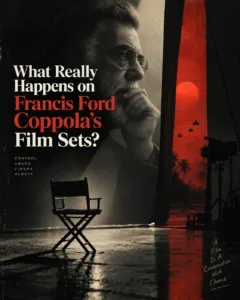
 The blood seen on Martin Sheen’s face in the opening scene of Apocalypse Now is not makeup, it’s absolutely real!
The incident took place on the night of August 3, 1976, in a two-story building in Manila. Downstairs, a real night court was in session, with real defendants and a real judge. Meanwhile, upstairs in a room, the camera was rolling.
Sheen was inside the room. It was his thirty-sixth birthday, and he had been drinking since morning. There was no dialogue written for that scene in the script; in fact, the scene itself wasn’t written. Coppola was rewriting the beginning of the movie and told the actor to do whatever he wanted. A direction came from behind the camera: “Scare yourself, Martin.”
Sheen punched the mirror. The mirror was made of real glass. His thumb was cut and began to bleed. Coppola wanted to stop the shoot and call a nurse, but Sheen folded his hands and pleaded, “Don’t stop the camera.” With his bloodied hand, he kept smearing his own blood on his face. Coppola did not turn off the camera.
That night, as Sheen was being carried down the stairs, the court downstairs was still in session. His thirteen-year-old son, Emilio Estevez, stood by the stairs and watched everything.
If incidents of this magnitude happen on a director’s set, how does the film ever get finished? This question recurs throughout the history of almost all of Coppola’s famous productions. The answer usually given is: the man is crazy but a genius. Madness is chaotic, but can madness sustain itself for five decades?
The answer must be sought not in that room in 1976, but thirteen years prior, during a nine-day shoot in Ireland.
Nine Days, Nine People
In 1963, Roger Corman finished shooting a low-budget movie called The Young Racers in Ireland, and some money was left over. Corman’s rule was that leftover money wouldn’t be returned; another movie would be made with it. A twenty-four-year-old Francis Coppola was working as a sound technician on that film. Corman gave him a chance with one condition: “Make something like Psycho, cheap and fast!”
Coppola wrote the script within a few days. He got a nine-day schedule at Ardmore Studios in Dublin, with a crew of nine.
The movie was named Dementia 13. After watching the rough cut, Corman said it couldn’t be released; it needed more gore, at least one more murder. Coppola didn’t agree. Corman then hired two other directors to add extra murders and a fake psychological prologue, where an actor looks at the camera and asks the audience, “Are you in the right state of mind to watch this movie?”
Coppola later said about this: “At some point, you have to leave the work in the hands of others.”
And at just twenty-five, he learned what happens when you don’t have control over your own work. From then on, he spent his entire life trying to regain that control over his creations. And every time, he had to pay the price.
Seven Hundred Pages
In 1970, Paramount gave this thirty-two-year-old the responsibility of making The Godfather because he was of Italian descent, he was cheap, and because many others had turned the offer down. Interestingly, he didn’t like the novel upon his first read. After reading it a second time, he realized it wasn’t a story about the mafia; it was a story about American capitalism, a story of a king with his three sons. Then he took Mario Puzo’s novel and cut the pages out with a razor blade. He cut rectangular holes in the middle of white papers and pasted the pages in such a way that both sides could be read, leaving wide margins for writing. He started writing in those blank spaces.
Four columns for each scene. Summary. Texture and tone. The core purpose of the scene. And the final column was named ‘Pitfalls’.
In the ‘Pitfalls’ column, he would write how he could potentially ruin the scene. In one column, he wrote in his own handwriting: “Make sure the Italians don’t talk like cartoon Italians.”
This column is worth remembering. Most directors prepare by figuring out how to get a scene right; Coppola thought about how it could go wrong. Sitting before each scene, he would preemptively anticipate where and how things could fail.
In theater, the notebook where the stage manager writes down every lighting cue is called a prompt book. Coppola made a similar notebook for himself out of the novel. He would take that seven-hundred-page notebook to the set during the shoot, not the script. To him, the script was just a part of that notebook.
Despite seven hundred pages of preparation, efforts to fire him began within the very first week of shooting.
The Day He Was Waiting For
The studio didn’t like Al Pacino. They wanted Robert Redford or Ryan O’Neal. Looking at Gordon Willis’s dark frames, head of production Robert Evans complained that nothing was visible on screen. The condition for casting Marlon Brando was that he had to do a free screen test and post a bond guaranteeing he wouldn’t cause any trouble during production.
Coppola knew he could be fired any day. Evans had even spoken to Elia Kazan about whether he would take over. Coppola later said he kept having a recurring nightmare where Kazan suddenly appeared on set to bid him farewell.
However, editor Aram Avakian was not part of that conspiracy. The Offer series portrayed him as part of the plot, although Coppola’s own statement says otherwise. Replying to a question on Instagram in 2023, he wrote that Avakian was the editor of his previous film, much like an older brother. When Avakian was offered the director’s chair, he reportedly said, “Francis is my friend, I can’t do it.”
According to an agreement with the Italian-American Civil Rights League, the words ‘Mafia’ and ‘Cosa Nostra’ had to be removed from the script. Producer Al Ruddy had agreed to it because he was in no position to object at the time. The word ‘Mafia’ was in the script only once. In the script of the world’s most famous mafia movie, the word ‘Mafia’ appeared exactly once. Eventually, even that was dropped.
Coppola finished the film while managing pressure after pressure. The seven-hundred-page notebook also came in handy. But some of the most memorable moments in the film weren’t pre-written in that notebook.
Lenny Montana, who played Luca Brasi, was a professional wrestler. Prior to that, he had worked for the Colombo crime family. He would get so nervous standing in front of Brando that he kept messing up his lines. Coppola kept those mistakes. Thus, in the movie, Montana is seen rehearsing his speech in front of a mirror, and then stumbling over his words in front of Don Vito.
The cat on Don Vito’s lap wasn’t in the script either. Coppola grabbed a stray cat from the studio lot and placed it on Brando’s lap.
Both incidents were minor things that happened during the shoot. Nobody knew then that another such incident would alter the final scene of a movie two years later.
The Scene Where Brando Didn’t Show Up
At the very end of The Godfather Part II, there is a flashback. The day Pearl Harbor was bombed is Vito Corleone’s birthday. The children are sitting at the table waiting for their father. Michael announces that he has joined the army. Sonny gets angry. Then there’s a noise at the front door. Everyone rushes out to surprise their father. Michael is left sitting alone at the table.
Brando was supposed to be in that scene. It was a one-day shoot, and he had agreed to it. But he hadn’t forgotten how Paramount had treated him during the first movie, from making him do a screen test to posting a bond. On the day of the shoot, he didn’t show up. He gave no explanation either.
Coppola rewrote the scene that very day. He removed Vito. As a result, the end of the film shows everyone leaving the table. Michael sits alone. The father everyone was waiting for never enters the frame.
Michael’s story repeatedly returns to this point. He wants to get closer to his father, yet ultimately drifts further away from him. And that distance became so vividly clear just because an actor didn’t show up for the shoot.
If a single absence changes the meaning of a scene, it can be called a coincidence. But in Coppola’s case, such an event didn’t happen just once. Around the same time, in the adjacent editing room, something similar was happening with another film.
Eight Words That Did the Job of Seventy-Seven Scenes
Between the two Godfather films, Coppola made a smaller film, The Conversation. Gene Hackman plays Harry Caul, a wiretapping expert. His job is to record other people’s conversations, but he is constantly paranoid about his own life.
This film is often conflated with the Watergate scandal. But Coppola had drafted it in 1966, and shooting was completed before the scandal broke out. In other words, the film wasn’t made as a reaction to Watergate.
The real action happened in the editing room. After shooting wrapped, Coppola had to leave to work on Part II. Editor Walter Murch was left alone with a massive mountain of footage. Nearly one-fifth of the screenplay’s scenes were never shot. The number was around seventy-seven. The purpose of those scenes was to slowly make the audience realize that Harry Caul had actually misunderstood what he heard.
Murch proceeded without those scenes. In the Union Square recording, one sentence comes back repeatedly: “He’d kill us if he got the chance.” For most of the film, the emphasis is on the word ‘kill’. It makes it seem like two terrified people are talking among themselves. At the end, the same sentence is heard again, but this time the emphasis is on ‘us’. Suddenly, the meaning of the phrase completely changes.
That second pronunciation was actually a blown take by Frederic Forrest. On the day of the shoot, it had been marked as a bad take and discarded. Murch later found that take and placed it at the end of the film. Consequently, many of the seventy-seven unshot scenes were no longer needed.
At this point, it feels like the pattern is no longer a coincidence. None of the most memorable moments were planned in advance. A stray cat, an actor not showing up, and a botched take that ended up staying.
That brings to mind the ‘Pitfalls’ column again. Preemptively writing down next to every scene where and how things could go wrong. Perhaps this is why Coppola could look at sudden chaos on set differently. Where someone else saw a mistake, he might have seen a possibility. The seven-hundred-page notebook wasn’t just for constructing scenes. It was also for understanding what to keep.
Accidents, therefore, play no small role in Coppola’s work. But accidents didn’t always work in his favor. For his next film, he had to pay a heavy price for it.
Labyrinth
In Greek mythology, the craftsman Daedalus built a labyrinth for the King of Crete, and the maze was so flawless that after building it, he couldn’t find his own way out. The craftsman became a prisoner of his own skill.
On March 1, 1976, Coppola landed in Manila with his family. The shoot was supposed to last five months. Ultimately, principal photography dragged on for 238 days.
For the first few weeks, they shot with Harvey Keitel in the role of Willard. After watching the footage, Coppola felt Keitel wasn’t portraying the character the way he wanted. Eventually, he was replaced by Martin Sheen. The previous shoots had to be redone. Then, on May 26, Typhoon Olga arrived and destroyed the Iba set. Production remained halted for several more weeks.
The helicopters were borrowed from the Philippine government. Sometimes, even in the middle of rehearsals, the pilots would be called away. They would fly the helicopters to the other side of the country for operations against communist rebels. Once the mission was over, they would return, and shooting would resume.
Brando arrived in September. The character of Colonel Kurtz in the script was a lean warrior. At the time, Brando weighed nearly three hundred pounds. He hadn’t read Joseph Conrad’s Heart of Darkness, nor the script. Coppola and cinematographer Vittorio Storaro then brainstormed how to present Kurtz. Finally, it was decided that he would be kept in the dark most of the time; only parts of his face would be seen in half-light. Brando’s full body was never shown.
Then, in March 1977, Martin Sheen suffered a heart attack. He was alone in the jungle at the time. With massive chest pain, he crawled to the road and then took a bus to the hospital. Upon arriving there, he even had a priest called in to administer his last rites.
Much of this was being captured on camera by Francis’s wife, Eleanor Coppola. She wandered the set with a 16mm camera. Initially, the job was for promotional purposes. The distributor wanted just about five minutes of footage. Eleanor ended up rolling the camera for nearly three years. She had met Francis on a movie set as well, during Dementia 13, where she was working as an assistant art director.
There is a tape in that footage where Coppola tells his team that if Marty dies, no one is to say anything to the outside world until he says so. In another tape, he says his biggest fear is making a “lousy, pretentious movie” on an important subject. He felt he was heading exactly in that direction.
During this time, he had mortgaged his house and vineyard. He had lost a lot of weight. He even suffered epileptic seizures. Eleanor’s diary notes that one day, in frustration, Coppola threw his Oscars out the window. The kids later picked them up from the yard. Four out of the five were broken.
In 1979, the film was screened at Cannes. It still wasn’t finished, so it was labeled “Work in Progress.” Coppola told the press, “My film is not about Vietnam, it is Vietnam.” They had more people, money, and equipment in the jungle than they needed. As the work progressed, the situation worsened. Even in that unfinished state, the film won the Palme d’Or that year.
He was eventually able to redeem the vineyard. But forty-five years later, that same land would have to be sold. Not for a mortgage this time.
Silverfish
After Apocalypse Now, Coppola turned to technology. He bought the Hollywood General Studios lot and built his own studio. Shooting would happen on soundstages, much like the old studio system, but using a new kind of technology. Coppola called this method “Electronic Cinema.”
The story of One from the Heart is set in Las Vegas. But Coppola didn’t go there for the film. A massive set of Fremont Street was built on a soundstage, from neon signs to the airport.
During the shoot, he wouldn’t be on set. An Airstream trailer named “Silverfish” was parked outside the studio. Video feeds from five stages would come in there. Inside, there was editing equipment, switchers, and a still store. From there, Coppola would monitor everything and direct the shoot. Simultaneously, a rough cut of the film was being assembled by splicing the shot footage together. Before shooting even began, a complete version of the film was created using storyboards and rehearsal videos.
One of Silverfish’s purposes was to pre-visualize everything as much as possible before the shoot. It also helped anticipate where problems might arise. The man who had thus far found great cinematic moments in sudden accidents was now working in reverse. He was trying to minimize uncertainty as much as possible.
But after One from the Heart was released, audiences didn’t show up at the theaters. Coppola’s studio couldn’t survive. He had to sell off everything, one by one. For the next decade, to pay off his debts, he had to make films where he didn’t have much freedom to direct by his own choices.
The movie he made right after his studio went under came as a proposal from a school librarian.
Tulsa’s Gymnasium
In March 1980, Jo Ellen Misakian, a librarian at Lone Star School in Fresno, California, sent an envelope to Coppola. She didn’t know his address, so she sent it to Paramount’s New York office. Inside was a paperback copy of S.E. Hinton’s novel The Outsiders, a letter, and a petition signed by 110 seventh- and eighth-grade students.
Misakian had noticed that the boys in school didn’t want to read books. Not even her own son. But they did read The Outsiders. So she wanted Coppola to make a movie out of the book.
Three months later, a reply came from producer Fred Roos. Two years later, filming began in Tulsa. At the end, the dedication credits listed Jo Ellen Misakian and the students of Lone Star School.
In Tulsa, Coppola built a temporary studio in a high school gymnasium. There, he ended up making two movies instead of one. After finishing The Outsiders, he started Rumble Fish, based on another novel by S.E. Hinton, using the same locations and mostly the same young actors. The first film was in color and highly romanticized. The second was black and white, heavily influenced by German Expressionism. Coppola himself called it an art film for teenagers.
During the rehearsals for Rumble Fish, he brought in Stewart Copeland, the drummer for The Police. His job was to work on the rhythm of the scenes. That is, it was decided before the shoot how fast a scene would move and where it would pause.
Clocks are seen throughout the film. On walls, in the streets, in the corners of frames. Copeland’s score also features a metallic ticking sound alongside the drums. The notion that time is running out is conveyed not just in the story, but in the sound as well.
In Coppola’s fifty-year career, The Outsiders was an exception. Someone else had asked him to make the movie. And the proposal for his next film came from someone with whom he had an old rivalry.
A Murder Financed the Movie
The Cotton Club was being produced by Robert Evans, Coppola’s old rival from The Godfather days. After Paramount backed out, Evans had to raise money from outside investors. Mario Puzo’s script had been rewritten some sixty times by then, yet it wasn’t working. Evans initially called Coppola just to fix the script. Coppola’s own studio was closed down, and he needed the money. He started the work and later took over the directorial duties as well.
Right before the shoot began, an investor went missing. Vaudeville producer Roy Radin was last seen in Beverly Hills on May 13, 1983. A month later, his remains were found outside Los Angeles. Later, a woman was convicted in this murder case. She was the one who had introduced Radin to Evans.
And during all this, Coppola stood on the set of a Harlem nightclub, shooting dance sequences every day.
Until now, his films had faced issues with money, time, or health. This time, it was something entirely different.
Father’s Share
Coppola was born in 1939 in Detroit. His father, Carmine Coppola, used to play in a radio program sponsored by Ford. Around that time, he had also invested in Preston Tucker’s car company. Tucker was building a car that was way ahead of its time. But the company collapsed due to lawsuits and financial troubles. A total of fifty cars were manufactured, and Carmine had put down a deposit for one of them.
On May 26, 1986, just days into the shooting of Gardens of Stone, Coppola’s eldest son, Gian-Carlo, died in a boating accident on the South River in Maryland. He was twenty-two. He had been learning second-unit work on his father’s set. The studio offered Coppola the chance to step away from the film. He didn’t; he finished the shoot. The film’s story itself was about the lives of the Old Guard, the soldiers who carry coffins at Arlington National Cemetery.
That same year, George Lucas, Coppola’s former assistant, revived the Tucker: The Man and His Dream project. As executive producer, he told Coppola that the film should be bright and optimistic, like a Frank Capra movie.
The condition sounds harsh. But Lucas’s logic makes sense. Coppola’s own life had somewhat mirrored Preston Tucker’s by then. Trying to do things his own way, he had repeatedly clashed with major studios and the corporate system. If he had been given another dark film to direct just months after his son’s death, it might have turned into a story of his own personal agony.
Coppola’s father, Carmine, wrote a jingle for a fictional radio ad in the movie. He composed the tune the night before the shoot. That very tune plays in the final scene when all of Tucker’s cars hit the streets together.
Film Kept in the Fridge
While making Bram Stoker’s Dracula in 1992, Coppola told his visual effects team that he didn’t want any computer-generated effects. Whatever happens on screen must be done in front of the camera.
Coppola’s idea was to bring back the techniques from the early days of cinema. The novel Dracula was written in 1897. Many early cinematic tricks were also born from magic shows. Coppola wanted the film to feel like old-school stage magic, much like the films of Georges Méliès.
The visual effects team did not agree to this. They kept insisting on using modern methods. Ultimately, Coppola fired the team and gave the responsibility to his son, Roman Coppola. Roman was in his twenties at the time and had a keen interest in stage magic.
Twenty-nine years earlier, Corman had brought in outside directors to work on his film. This time, Coppola gave the visual effects job to his own family.
Father and son utilized many old-fashioned techniques: running the film backward, forced perspective, shadow puppets, miniatures, and double exposure. For the double exposures, after shooting a scene, they would meticulously note the film’s details and keep it in the refrigerator. A week later, they would load the exact same film back into the camera and shoot the next scene right over it.
This way, there was no need to add effects separately in post-production. Everything was being created in camera.
The green mist that seeps into Winona Ryder’s bedroom was also created practically. A fifty-fifty mirror—something found in magic shops and rarely used in Hollywood for years—was placed in front of the camera. On another set at a ninety-degree angle, dry ice smoke was released, and green light was shone on it. The smoke reflected in the mirror and appeared inside Ryder’s room. There is only one computer-generated effect in the entire movie, right at the very end.
Computer-generated images from that era look like toys if you watch them today. But the light and shadow work in Dracula still stands out. Because they were created with real light and right in front of the camera.
Thirty years later, Coppola would walk the same path again. Though this time, right in the middle of shooting a film.
The Vineyard
The idea for Megalopolis came to Coppola at the end of the seventies. He started taking regular notes on it from 1983. In 1989, an office was even set up at Cinecittà Studios in Rome. But work halted due to the pressure of paying off debts.
In 2001, he resumed work on the film. Table reads with major actors took place in New York. Over thirty hours of footage were shot across the city. The story was about rebuilding a destroyed metropolis. But the September 11 attacks happened while shooting in New York. The project was shelved again. This time for nearly two decades.
Finally, the film was made with Coppola’s own money. Since no studio agreed to finance it, he sold off a large portion of his vineyard. The land he had bought with the profits from The Godfather and mortgaged during Apocalypse Now ultimately funded his final film. He was eighty-five years old then.
Midway through the shoot, he fired his visual effects team again, just like he did during Dracula. The production designer left too, and the press reported chaos on set.
After its premiere at Cannes, the audience gave it a seven-minute standing ovation, while critics were split down the middle. Some called it a masterwork, others called it a colossal folly.
The man who made his first movie using someone else’s leftover money during a nine-day shoot in Ireland, sixty-one years later, spent all his own money to make his final film. During this time, he repeatedly tried to seize control over his work. And every time, he had to pay a steeper price for it.
Preparation and Accidents
But what did he do with that control?
Every time he gained control, he created environments where something unexpected could happen. In the Philippine jungle, he borrowed the army of a country that was actively fighting a real war. Instead of the real Las Vegas, he built a plywood Las Vegas; instead of digital, he used film kept in a fridge. To finance his final film, he even sold off a large chunk of his vineyard. Daedalus built a labyrinth and got trapped inside. Coppola repeatedly walked into his own labyrinth.
Why? It’s hard to say for sure. But looking at his work gives us an idea.
Corman had taught him that it’s problematic when outsiders interfere with the work. Later, Coppola discovered another side to this. Even after planning everything in a movie, some spaces need to be left open. He wanted a space where no outsider could intervene, yet where the unexpected could unfold from within. He repeatedly spent his money just for that freedom.
That’s why many of his most famous moments were never pre-written. Brando didn’t show up for the final scene of The Godfather Part II. An actor’s botched take altered the meaning of the ending in The Conversation. Martin Sheen was genuinely injured in the opening scene of Apocalypse Now.
Because of these methods, it wasn’t just the director, but those around him who also had to pay the price. Martin Sheen couldn’t bear to watch that scene for many years. Eleanor Coppola spent three years documenting the events on camera. And a man tied to the financing of The Cotton Club was murdered. Not everything can be neatly accounted for.
Still, the ‘Pitfalls’ column in that seven-hundred-page notebook comes to mind. Next to every scene, Coppola had written down how it could be ruined. After all these years of work, it seems a huge part of preparation was learning to recognize the unexpected.
His job wasn’t just to plan everything in advance. Developing the eye to retain a sudden, unscripted moment was also part of his job. And sometimes, just not turning off the camera was enough.