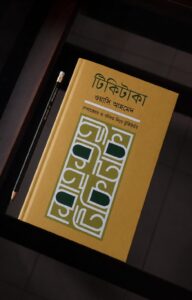
 Continuing the thread of our ongoing literary reflections, this rich and insightful reading reaction is shaped into an engaging, structured book discussion. Preserving personal observations, literary references (such as poet Sakhawat Tipu’s remarks), and striking metaphors (such as mitigating sins through stolen donations), it polishes the prose into a compelling literary exploration.
Book Review: A Masterful Chronicle of Reading, Wandering, and Literary Camaraderie
If you wish to quickly enrich your intellectual coffers and immerse yourself in the varied facets of literature, books of this calibre have few equals. Here unfolds an exquisite confluence of the author’s reflections on literature, lived experiences, and intimate observations. As an inveterate wanderer himself, the author transcends conventional travelogues to unearth rare literary gems from distant lands—revelations that are truly extraordinary. For instance, discovering where secondhand bookshops hide in far-off countries and what treasures line their shelves can be savored right from a quiet corner of Dhaka, all thanks to this book!
Nowadays, the tradition of sitting down for long, rambling literary chats with authors has all but vanished. Those bustling, lively literary addas centred around Aziz Super Market now feel like distant folklore. If only one could sit face-to-face with essayist and fiction writer Wasi Ahmed for an unhurried, heartfelt conversation—this book graciously consoles the reader’s lingering regret.
Flipping through its pages in an effortless conversational tone, one learns how many hundreds of times monumental novels in world literature were rejected before finally seeing print. The globally cherished Narnia series was turned down 700 times, and Margaret Mitchell’s classic Gone with the Wind was rejected 38 times! Gone with the Wind was Mitchell’s sole novel, written primarily in retort to her husband’s taunt: “You read so much, yet I’ve never seen you write a single line!” One cannot entirely dismiss the possibility that the grueling ordeal of getting it published was why she never wrote another word. Even modern phenomena like Harry Potter bear tales of repeated rejection. Yet what struck me as most amusing was when publishers, refusing to print a manuscript, would pen exhaustive manifestos explaining why it was ‘unfit for publication.’ Among them, the rejection letter sent to Ernest Hemingway was perhaps the most ruthless! The book contains a delightfully witty chapter dedicated to such publisher misjudgments. While the works mentioned did eventually see the light of day, who knows how many masterpieces were swallowed forever into oblivion by the arbitrary dismissals of publishers!
Throughout the book, Wasi Ahmed frequently discusses writers who produced very little in volume yet triumphed over time. This inquiry opens with the fiction writer Biplob Dash. Personally, I had never heard of him. The author himself notes that Biplob Dash is today nearly forgotten, rarely invoked in any literary circle. Yet illustrating just how singular his narrative craft was, Ahmed writes, “In our fiction, he has no predecessors.” This spontaneous praise stirred within me an irresistible urge to seek out Dash’s writing.
A similar sentiment is evoked regarding Akhtaruzzaman Elias. Elias, too, wrote sparingly, yet the indelible imprint he left upon Bengali literature is one that none can surpass. However, Wasi Ahmed’s sorrow lies elsewhere. He laments that for want of capable translators, the wider world remains entirely unaware of Elias’s formidable literary genius. And is it only Elias? There are dozens of monumental novels in the Bengali language that remain hidden from global readers year after year simply due to a dearth of translation. On this point, I am reminded of poet Sakhawat Tipu’s remarks at the Boi Mela’s ‘Lekhok Mancha’ a few days ago. He observed, “Bangla Academy fails to perform the very duties it was created for. Translating Bengali language and literature to share it with the world is fundamentally their responsibility. They even have a translation division, yet what they actually do—or whether they translate anything at all—remains entirely beyond my knowledge.”
The author mounts a stinging critique of the Nobel Prize. He details how the Nobel Committee was swayable by geopolitical politics, denying the laurel to epochal giants like Leo Tolstoy, Anton Chekhov, Jorge Luis Borges, and Franz Kafka—a historical account that felt completely eye-opening to an ordinary reader like myself. Reading about the politics of the Nobel Committee brings an ironic smile to one’s lips regarding the literary academy awards of our own country. It seems that among prize committees worldwide, the concept of ‘perfection’ is non-existent. Compromise reigns supreme! Everywhere, they bestow awards upon hordes of undeserving individuals, only to later attempt damage control by honouring one or two worthy names—much like attempting to cleanse sins by donating stolen wealth to a mosque or temple!
That Wasi Ahmed is an avid reader to his very bones before ever putting pen to paper is richly demonstrated in essays like “Reading Changes” and “Shahid Qadri of Uttaradhikar.” I resonated profoundly with the section ‘Reading Changes.’ Just as a reader evolves, a piece of writing that may have left us cold at one point in life can suddenly open its innermost chambers to us years later as our age and sensibility mature. Wasi Ahmed’s manner of articulating this evolution of reading is nothing short of brilliant.
Every chapter of the book is so laden with intriguing anecdotes and ripe experiences that the thought lingering most persistently after closing it is: when will Wasi Ahmed write his autobiography? How thrilling the memoir of a writer so enriched by reading and lived experience would be needs no elaboration.
Sitting down to write about this book, I have no desire to end up writing an entire book myself. And so, I draw this conversation of wonder to a close.