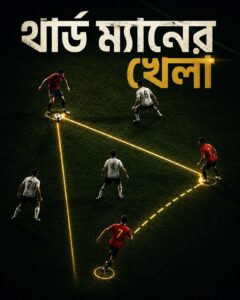
Stuttgart, July 5, 2024. Euro quarter-final, Spain versus Germany, 1–1. The clock has reached the 119th minute, and the entire stadium sits holding its collective breath for a penalty shootout.
On the right wing, Ferran Torres collects the ball. He flicks it to bypass Maximilian Mittelstädt, gets obstructed, and the ball loops loose into the air. Dani Carvajal retrieves it and switches play across the pitch to Marc Cucurella.
Where is Mikel Merino at this exact second?
Before the ball even reaches Cucurella’s feet, Merino has darted across him toward the edge of the penalty box. By clearing out, Merino vacates the lane in front of Cucurella. Cucurella feigns a shot, hesitates, and lays it wide to Dani Olmo. Olmo’s cross. Merino’s header. Goal! Germany is knocked out of their home tournament.
What the highlights show is that cross and that header. Merino’s initial decoy run is absent from every replay. Yet that was precisely where the goal was won.
In coaching manuals, the diagram is drawn simply: A passes to B, B lays it off to C, C is free.
It is so simple it arouses suspicion. Eleven against eleven. There are no surplus players on the pitch; nobody is hiding in the shadows. Where, then, does this free man come from?
The textbook explanation says that as defenders collapse toward B, space opens for C. Plausible, but incomplete. Because even if a defender shifts, C’s marker could easily stand his ground. But he doesn’t. Or if he does, he reacts a beat too late.
The third man is not forged in open space; he is forged in a sliver of time. And that sliver appears the split second a defender’s eyes look away.
In 1999, Harvard psychologists Daniel Simons and Christopher Chabris conducted an experiment. Participants were shown a video of six people passing basketballs—three wearing white shirts, three in black. Their instructions were simple: count the passes made by the team in white.
Midway through the clip, a person in a gorilla suit strolled into the frame, thumped their chest facing the camera, and walked out.
Nearly half the viewers never saw the gorilla. The research paper was titled “Gorillas in Our Midst”, and the phenomenon was named inattentional blindness: where the mind focuses, the eye turns blind.
The most crucial element of the experiment was the instruction. The subjects were told to count passes. The very act of tracking the ball rendered them blind.
A defender is saddled with that exact assignment: watch the ball, track your man, hold the line. In the split second it takes a human neck to swivel, a person is effectively blind. The first pass does not aim for the goal; it aims for the opponent’s eyes.
In the Mahabharata, on the day Jayadratha was slain, Krishna veiled the sun. Believing dusk had fallen, Jayadratha emerged from his protective cover, and Arjuna struck him down. Krishna’s weapon was not an arrow; it was an illusion planted in his enemy’s gaze.
A quote from Pep Guardiola is widely cited in coaching circles: the objective is to move the opponent, not the ball.
Manchester City right-back Kyle Walker was once asked why he tucked in so close to the center-backs rather than hugging the touchline. Walker replied that the boss dislikes passes longer than three meters—he insists on keeping them short specifically to bait the opponent’s marker out.
A three-meter pass takes the ball nowhere. It takes the opponent somewhere.
The same misunderstanding surrounds the rondo. From the outside, it looks like a passing drill: two players chasing inside a circle while six circulate the ball on the perimeter. Circulating the ball is merely the pretext. What is drilled into instinct is reading the exact micro-second an opponent’s gaze shifts, and finding the furthest player on the pitch.
In the vocabulary of Spanish positional play (Juego de Posición), there are two distinct concepts: hombre libre, the free man standing unmarked behind the pressing line; and tercer hombre, the third man. The structural framework of this language was codified by Juanma Lillo—the Spanish coach whom Guardiola regards as his mentor and later brought to Manchester City as his assistant. In the twilight of his playing career, Guardiola traveled to Dorados de Sinaloa in Mexico solely to play under Lillo, showing up to training sessions notebook in hand.
Among the trio, the least celebrated actor is B. He receives the ball with his back to goal, often with a defender breathing down his neck. There is no angle to turn. His task is to release the ball with a single touch, pinning his marker to his back as he releases.
The only man on the pitch who touches the ball yet reaps nothing from it.
In Spanish football, this mechanism is called a pared—literally, a wall. In English, a wall pass. Just as a wall rebounds a ball while rooted to its spot, so does B. This is the hardest discipline to instill in footballers, because young midfielders crave turning on the ball. Turning keeps the spotlight on yourself. But if B turns, his marker is released—and a liberated marker sprints across to swallow C.
Two concepts are routinely conflated here. A third-man combination is a transaction of the ball: three players, two passes, one free receiver. The third man is the target. While managing Fulham, Scott Parker noted that the concept of hunting the third man ran through every training session, with dedicated drills at least once a month—ramping up whenever facing high-pressing opposition. A third-man run, by contrast, is a transaction of the eyes. Here, the third man may never receive the ball. He is the bait. His movement fractures the defender’s focus, vacating territory into which someone else rushes.
There is a biological limitation to a defender’s vision that no training can overcome: no human can view both the ball and his marker simultaneously once the marker drifts behind his shoulder line. That is why elite third-man runs almost invariably emerge from the blind side, skimming past the defender’s back shoulder. Run across his chest, and he tracks you. Run behind his back, and you force an agonizing choice: track the ball, or track the man.
Merino’s goal is such an immaculate study because he played both roles in a single sequence: first darting forward to clear the space for Cucurella, then resurrecting as the third man to power home the header.
In 1908, German sociologist Georg Simmel demonstrated in his Soziologie that a relationship between two people and a relationship among three belong to entirely distinct species. What transpires between two belongs only to those two. Introduce a third, and the structure mutates; dynamics become possible that a dyad could never achieve. Simmel categorized three archetypes of the third entity: the mediator who binds the two; the tertius gaudens—the ‘rejoicing third’ who profits from the conflict of the other two; and the divider who governs by sowing discord.
In Norse mythology, Loki cast nothing with his own hands to slay Baldr. He merely placed the mistletoe dart into the hands of the blind god Höðr and guided his aim; the bloodguilt was written in Höðr’s name. In football’s third-man geometry, who truly plays the role of Loki? Not the third man, but the initial passer. He ignores the easy pass, invites pressure onto his own chest, and risks losing possession—yet his name is completely absent from the official statistics.
In 1950s England, an accountant serving in the Royal Air Force named Charles Reep sat in stands tallying tick marks on notepads. He was football’s first prominent data analyst. Reep’s calculations purported that roughly eighty percent of goals came from moves of three passes or fewer. His deduction: the quicker the ball is launched forward with minimal passes, the better. Charles Hughes, the FA’s director of coaching, canonized this dogma into the English football curriculum: long balls, high floating crosses, and aerial combat bypassing midfield. An entire generation of English midfielders was squandered.
Another figure of Reep’s is rarely cited: half of the goals he recorded stemmed from moves of zero or one pass—set pieces and defensive blunders. This contradicted his own thesis, yet the nuance was buried. The flaw was baked into Reep’s sample: 91.5 percent of all moves he logged consisted of three passes or fewer. Yet only 80 percent of goals emerged from them. Which meant short, direct sequences were actually less efficient, not more. Decades passed before Jonathan Wilson unpacked this statistical fallacy.
Around that same era, on the other side of the world, another man was counting to three—in an entirely different way. In 1968, Valeriy Lobanovskyi crossed paths with Anatoly Zelentsov, bringing him to Dynamo Kyiv in 1973. What they erected was not a coaching staff, but a cybernetic laboratory. Zelentsov categorized the game into 22 discrete actions, isolating what he called ‘coalition actions’—synergies enacted by groups of players. Lobanovskyi operated on the principle that the efficiency of a subsystem always exceeds the sum of its isolated parts. In both hemispheres, the number was three. In England, three was a ceiling on passes. In Kyiv, three was the smallest atomic team. From the identical digit emerged two divergent philosophies of football: one counted the ball, while the other counted human relationships.
In modern event data, analysts identify third-man dynamics through the network-theory model of triadic closure: three nodes, three ties, one passing triangle. Georg Simmel had articulated the sociological blueprint of that geometric triangle all the way back in 1908.
There is an unspoken condition of the third man that few discuss: he must start running before the pass is ever delivered. Where the ball will land remains entirely uncertain. The initial passer may not have spotted him, or may lack the audacity to attempt the incision. Thus, most of these decoy runs dissolve into thin air. But for the player who commits to the run again and again, space eventually yields.
On that night in Stuttgart, the official ledger etched two names: assist to Olmo, goal to Merino. Cucurella’s choice not to pull the trigger remains completely off the books.