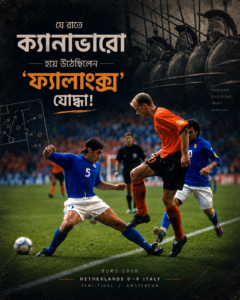
The clock at the Amsterdam Arena showed barely thirty-four minutes when the referee raised a red card (a second yellow) before Italy’s Gianluca Zambrotta. His transgression was hardly egregious; he had merely stepped into the running path of Boudewijn Zenden. Yet he had already picked up his first yellow card in the fourteenth minute for tripping that very same Zenden!
The semifinal of Euro 2000, facing the tournament hosts, the Netherlands. Fifty-six minutes of regulation time, plus an agonizing thirty minutes of potential extra time—for this entire eternity, Italy would have to survive with ten men! On paper, the mathematics of a red card are simple: one player fewer on the pitch. But at that moment, Dino Zoff’s side lost far more than a single player; they lost their entire right flank.
Zoff’s tactical blueprint was built on a 3-5-2. At the back stood the impregnable citadel of Fabio Cannavaro, Alessandro Nesta, and Mark Iuliano, flanked by wing-backs Zambrotta and Paolo Maldini. The duties of a wing-back are inherently doubled: a winger in possession, a full-back when defending. With Zambrotta sent down the tunnel, Italy’s right side was left completely bare.
Left with no alternative, Zoff reorganized into a 4-4-1. Maldini dropped from wing-back to orthodox left-back. The back three fractured into a back four, and the monumental responsibility of anchoring the right side fell squarely upon the shoulders of Fabio Cannavaro. Leading the line was a solitary Filippo Inzaghi, with Alessandro Del Piero stationed to his right in midfield.
In the traditional grammar of defending, full-backs rarely operate in isolation; they work in tandem with the winger ahead of them. When the opposition advances, the winger tracks back, doubling up to seal off the crossing avenue. But Del Piero was not forged in that mold. He was an uncompromising number ten whose duty during defensive phases was to linger high up the pitch. Consequently, Cannavaro was plunged into a tactical nightmare.
The predicament bore an uncanny resemblance to the hoplite soldiers of ancient Greece. They fought locked shoulder-to-shoulder in a formation known as the Phalanx. A shield in the left hand, a spear in the right. A warrior’s left side was guarded by his own shield, but his right remained fatally exposed—sheltered solely by the shield of the comrade standing directly beside him. Security demanded absolute, blind faith in the man to one’s right. The historian Thucydides, describing the Battle of Mantinea, noted that as armies advanced, the entire formation inexorably drifted to the right, as every soldier instinctively sought cover behind the shield of his companion.
When Zambrotta departed, precisely this phenomenon unfolded across Italy’s defensive line—only this time, orchestrated by Zoff’s tactical design. Maldini shifted left, while Nesta and Iuliano slid laterally toward the right. And Cannavaro stood at the absolute precipice of the line. To his right, there was no one left to trust.
Yet how could ten men hope to seal off an entire wing? Cannavaro never even attempted it. Italy practically extended an invitation to the Dutch: ‘Play down the touchline.’ Whether it was Marc Overmars, Zenden, or Giovanni van Bronckhorst surging down the outside, Italy offered no resistance. They conceded crosses with serene indifference. Because Italy’s real preoccupation lay inside the penalty area. There, Nesta, Iuliano, and Maldini himself stood guard. If the ball took flight, Italy had nothing to fear.
Cannavaro’s true battlefield was within. The primary danger always germinates in the narrow ‘half-space’—the insidious channel running between full-back and center-back. Had Cannavaro chased the winger all the way to the touchline, that corridor would have been ripped wide open. And had Patrick Kluivert or Dennis Bergkamp slipped through that seam, the final nail would have been hammered into Italy’s coffin. Cannavaro refused to take the bait. He allowed the crosses from out wide, but refused to let his distance from Nesta widen by even an inch.
The Dutch held a numerical superiority, yes, but that extra man was isolated on the remote periphery of the pitch, where his presence was harmless to Italy. As long as the Dutch winger remained glued to the touchline, he had only empty turf before him. Danger materialized only if he cut infield with the ball. And right at that doorway stood four Italian defenders carved from granite, shielded by the midfield sentries Demetrio Albertini and Luigi Di Biagio.
The contest stretched to 120 minutes. Though the Dutch monopolized possession throughout, their two clearest opportunities arose not from tactical incision, but from Italy’s own blunders. In the thirty-eighth minute, Nesta conceded a penalty by tugging Kluivert’s shirt in the box. But diving to his left, Francesco Toldo produced an astonishing save to deny Frank de Boer. Shortly after, Iuliano bundled over Edgar Davids. Another penalty! This time, Kluivert sent Toldo the wrong way, only to watch his strike ricochet off the post.
And Toldo was playing this tournament through sheer strokes of fate. On the eve of the Euros, Gianluigi Buffon broke his hand in a warm-up friendly. Prior to that, Angelo Peruzzi had abandoned the squad, refusing to sit on the bench as Buffon’s deputy. Thus, third-choice keeper Toldo was abruptly thrust into the starting shirt, and on that magical night in Amsterdam, he became the nation’s savior.
In the seventy-seventh minute, Dutch manager Frank Rijkaard conceded defeat and substituted Zenden. The very winger who had terrorized Italy’s right flank for the opening half-hour was hauled off having extracted nothing from that corridor. He had been thoroughly outthought by Cannavaro’s tactical mastery.
That night, the twenty-six-year-old Cannavaro plied his trade for Parma. As a center-back, he lacked towering height, nor was aerial dominance his primary weapon. His genius lay in his blistering positional recovery, his ability to extinguish danger behind his backline, and his refusal to be beaten in 1v1 situations. Center-backs traditionally defend what lies ahead; Cannavaro excelled at defending the horizontal axis. For eighty-six grueling minutes in Amsterdam, he was tasked with accomplishing the impossible—and delivered.
Following that tournament, Maldini bowed out of international football, and the captain’s armband was entrusted to Cannavaro. Six years later in Berlin, it was Cannavaro who hoisted the World Cup trophy aloft, claiming the Ballon d’Or in the process. To this day, he remains the last defender to win that coveted accolade.
Yet the crowning irony of that night in Amsterdam lay elsewhere. Across 120 minutes of combat, the Dutch never once engineered a clean 1v1 breakaway against the goalkeeper from open play. That privilege belonged exclusively to ten-man Italy—not once, but twice! Had Edwin van der Sar not repelled Marco Delvecchio’s two point-blank strikes with his outstretched legs, the evening might have ended in far deeper sorrow for the Oranje.