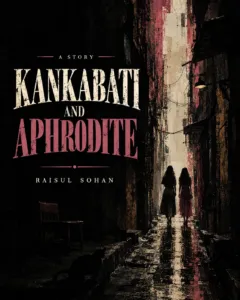
In this alley the morning comes as a smell instead of as light. The smell of stale oil, the smell of the drain, the smell of mosquito coils that burned all night and finished, and the smell of the mouths of sleeping people. The lights are not switched off; having nothing left to do, they simply hang there, yellow. The chicken seller lowers his cages, and inside the cages the chickens do not know what will happen today. They never know. They live each day new; and for this one quality a chicken is happier than a man.
A rickshaw stops at the mouth of the alley. Two girls get down. They pay and walk on, side by side, but neither looks at the other. All that way from Lalmatia they have not said a word.
Kankabati has money inside her blouse. Aphrodite has money inside her blouse too. The money has gone warm on their breasts, the money is wet with sweat, the money has become part of their bodies, the way it does every day. But today the money feels different. Today it feels like something a person left behind by mistake, something that ought to be returned, and they do not know who to return it to.
Inside the room Aphrodite bolts the door. Kankabati sits down on the cot, then lies down, then sits up again.
Kankabati says, Chhabiron.
Aphrodite starts. Nobody calls her that. Nobody has called her that in seven years. She says, What?
Kankabati says, Nothing. I just called you.
The two of them stay quiet. Outside a crow is calling, and goes on calling, as though the crow also has something to say and will not, in a whole lifetime, get it said.
Aphrodite says, Jarina.
Kankabati says, Yes.
Aphrodite says, What happened last night?
Kankabati is quiet a long time, then says, Nothing happened at all.
Aphrodite says, If nothing happened, why do I feel like this?
Kankabati does not answer. Because she does not know the answer; because an event in this world must have a name, and an event with no name has not occurred. Both of them have known all their lives that there is only one event on earth. The kind that enters the body. What enters only through the eyes is not an event; that is a lie, that is theft, that is madness.
They try to sleep. Sleep does not come. Not sleeping is new to them; whoever survives in this line can sleep at any hour, in any condition. Sleep is their only property, their only house, their only country. Today the borders of that country are shut.
Around noon Sufia khala comes.
Khala says, So you’re back. How much did he give?
Kankabati takes out the money. Khala counts it. As she counts, her face changes; a large sum makes a person suspicious, more than a small sum does.
Khala says, Why so much?
Aphrodite says, He gave it.
Khala says, How many times did he do it?
Kankabati says, Not once.
Khala does not understand at first, then bursts out laughing, laughing until her eyes water, laughing until she sits down on the cot, laughing as she says, Not once? Then what was the money for? For the air? Are there no men left in this country, is he buying air now?
Aphrodite says, Khala, he’s a different sort.
Khala stops laughing and says, There is no different sort of man. Man is one sort. You two are hiding something. You’ve stolen.
They say nothing. Because to say anything they would have to say what happened, and for what happened they have no language. Khala has none, this alley has none, this city has none, this tongue has none.
Khala takes the money, and on her way out she says, The two of them have gone mad.
In the evening the other girls of the house gather. They want to hear. Anywhere on earth, anyone wants to hear about another person’s night, because to bear your own night you need someone else’s.
One of them asks, Was the light on?
Aphrodite says, Yes.
They all make a sound together, because a light left on means bad manners, a light left on means shame, a light left on means being seen.
Another asks, And then?
Kankabati says, Then he talked.
— Only talked?
— Only talked.
— Talked about what?
Kankabati opens her mouth and closes it again. She remembers all of it; she has not lost a single word; but if she brings those words into this room they will die, she understands that much. What people do not understand, they kill; and having killed it, they laugh.
She says, I don’t remember.
The girls get bored and leave. On the way out one of them says, Rice in front of her and she won’t eat it. She eats air.
But Kankabati remembered.
The man had said, That darkness under your eyes, that isn’t darkness, that’s shade; shade falls under a tree, which means there is a tree inside you.
The man had said, You don’t know the name of this bone and neither do I, so I’ll give it one — bridge. People cross from one bank to the other over it. There’s a bridge on your shoulder, Jarina. People cross over through your body, and nobody thanks you.
The man had said, There’s a song inside your throat, I can hear it. Why don’t you sing? Do you lose customers if you sing? Then don’t sing. Sing once in front of me. You won’t lose customers. I’m not a customer.
Kankabati did not sing. All night she wanted to sing and all night she did not. Now, this evening, the unsung song is lodged in her throat like a fish bone, and it will stay lodged there all her life.
Three days later Kankabati begins to talk.
A customer comes and puts his hand on her body, and she says, That’s a bridge.
The customer says, What?
She says, The name of that bone is bridge. You’re crossing over.
The customer stops short, then turns angry. What a man does not understand first halts him, then enrages him. The customer says, I paid to watch a play? He goes downstairs and shouts at khala, khala comes up and takes hold of Kankabati and shakes her, and Kankabati looks into khala’s face and says, Khala, there’s shade under your eyes too. There’s a tree inside you too.
What happens after that does not need describing. In every country, in every age, whoever speaks in the wrong language comes to the same end.
A month or so later Kankabati leaves. Nobody knows where. Khala says, The madwoman is dead. The girls say, Who knows.
Aphrodite says nothing. Aphrodite stays silent for seven years, and then for eleven more.
She tells nobody anything. She has learned that there are certain things which, once said, do not survive. She puts that night away somewhere inside her body where no customer reaches, no khala reaches, no police reach, no landlord of a broken house reaches. Sometimes at night, alone, in the dark, she lays her hand on the bone of her own shoulder and says nothing, only lays her hand there.
When a woman grows old this alley puts her out — not cruelly, only slowly, the way a tide goes out. Aphrodite is no longer Aphrodite. Now she is Chhabiron. She washes dishes at a boarding house, swabs the stairs, hangs the clothes out on the roof. Nobody looks at her. She likes it. After a lifetime of enduring eyes that look, eyes that do not look are like a holiday.
One winter afternoon, passing a secondhand book stall on the footpath, Chhabiron sees a face. A photograph printed on the back of a book, black and white, blurred. The man’s hair has gone grey. But Chhabiron stops, because the body does not forget a face; the body has a brain of its own.
She picks up the book. Turns it over. Black letters, white paper, line after line. She does not know letters. She has never known letters. Never in her life has that fact seemed as large to her as it does today.
The boy at the stall says, Buying it, khala? Eighty taka.
Chhabiron says, Son, read me one line.
The boy is annoyed, then for some reason he reads. Chhabiron listens. About a river, about birds, about winter. Nothing about her. Nothing about them. Nothing about that night.
Chhabiron nods. She says, Yes. That’s it.
Because eighteen years later, standing on this footpath, she understands today that to see is not to write. That man had not written them. He had seen them. On this earth the two are separate things. The second is rare, and it leaves no proof.
Eighty taka is a day’s rice for her. She pays the eighty taka.
At night, under the stairs of the boarding house, she takes the book out from beneath her mattress and opens it. She lays her hand on the page. The black letters lie on the white paper like grass. Dense, small, countless, each one joined to the next.
Chhabiron runs her hand over it. The field is here.