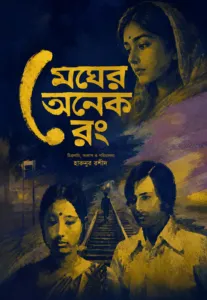
 The film opens with green. Mountains held in wide frame, a road snaking down the slope, and upon that road, a tiny car. The camera cuts inside. Two people are speaking, exchanging the most mundane, ordinary words. Cut again: back to that vast expanse of verdant green, inside which the car shrinks even further.
Show these three shots to any contemporary cinephile with the credits concealed. They will say: Malayalam cinema. Over the past decade, the Malayalam film industry has turned this very grammar into its signature. The landscape speaks, the asphalt speaks, the interior dialogue is deliberately kept trivial, and the viewer senses that the narrative is advancing within something far vaster than mere mortals.
The plot, in brief, is this: During the Liberation War, Dr. Omar’s wife, Ruma, is abducted by the Pakistani military. Unable to find any trace of his wife and infant son, Omar joins the armed resistance. Amidst the war, a young indigenous hill woman, also a physician, named Mathin, stands beside him. When the war concludes, the two build a life together. Some two years later, seated inside a women’s rehabilitation center, Ruma learns that her husband is alive and living in happiness. Ruma chooses never to reveal herself to anyone. Finding an opportune moment, she leaves their son Adnan at Omar’s doorstep, and then takes her own life. Receiving word of a woman’s suicide at the rehabilitation shelter, Omar rushes there, identifies Ruma’s corpse, and realizes with crushing finality that the boy taken into his home is his own flesh and blood.
For the story to reach its conclusion, Ruma had to die. Had she remained alive, no ending would have been possible for this film.
Shortly after liberation, on November 10, 1972, Subhash Dutta released Arunodoyer Agnishakkhi, extending an impassioned appeal to embrace and rehabilitate the Birangonas (war-heroines) and the war-babies. Exactly four years later, in the very same month of November, Harunur Rashid returned to the identical question. Yet he brought no idealistic plea; he brought its unsparing, brutal reality.
Harunur Rashid’s own trajectory was peculiar. Born on March 15, 1940, in Kushtia. His initiation into cinema occurred in 1963 as an assistant director on Salahuddin’s Dharapat. Subsequently, he assisted legends like Zahir Raihan and Bashir Hossain, and even acted in a couple of features. It took him thirteen long years to emerge as an independent auteur. And for his directorial debut, he chose a subject that nobody in the commercial market dared touch.
Helen Never Went to Troy
The Greek lyric poet Stesichoros, and after him the dramatist Euripides, penned an alternative myth of Helen. In their telling, Helen never set foot in Troy. The Olympian gods fashioned an identical phantom of Helen out of celestial clouds and delivered it into the hands of Paris, while the true Helen languished for ten years in Egypt. Thus, that catastrophic decade of war, the thousand ships, the wrath of Achilles, the fall of Hector—all unfolded around a cloud.
To the Hellenic mind, a cloud was never merely meteorology. Zeus once sculpted Nephele, a cloud-phantom bearing the exact likeness of Hera, and placed it before Ixion; Ixion embraced the cloud believing it to be Hera herself. The very word Nephele signifies cloud. In Greek mythology, a cloud is that phantom construct which mankind invents when looking directly at the real, flesh-and-blood body becomes an unbearable terror.
When the war drew to a close, Menelaus reclaimed Helen. There was no trial by fire, no desolate exile. For the Greeks had proactively manufactured a cloud, ensuring Helen could never be pronounced guilty. To rescue their heroine, the Greeks had devised an escape: its name was the Cloud.
The Indian subcontinent chose an entirely different stratagem. In the Ramayana, after the slaying of Ravana and prior to taking Sita back, Rama demands she undergo the Agnipariksha—the trial by fire. Sita enters the flames and emerges immaculate. Even then, whispers and slander circulate in Ayodhya, and the pregnant queen is banished to the forest. Years later, when proof is demanded once more, Sita refuses to enter the fire. Handing over her twin sons, Lava and Kusha, into Rama’s care, she summons the Earth. The earth splits asunder and swallows her whole.
Sita’s final two acts unfold in a rigorous, unbroken sequence: first, the surrender of the children; then, her own disappearance. Ruma executes her final acts in this identical order. First, she deposits Adnan safely under his father’s roof; then, she erases herself. Across a gulf of two and a half millennia, two women take the exact same two strides in the exact same order.
Whether Harunur Rashid consciously invoked Sita’s archetype, I do not know. Yet looking back, it becomes apparent that he had no alternative. In the Bangladesh of 1976, it was impossible to write a screenplay where Ruma lived. If Ruma lived, the film could not conclude; only an insoluble dilemma would remain. One man, two wives—one of whom the state had decorated with the title of Birangona, yet upon whom society could not bear to gaze. For this moral equation, the Bangladesh of that era possessed no resolution. Consequently, resolution arrived disguised as death.
And here, the film’s title echoes with an unsettling resonance. Megher Onek Rong—Many Colors of the Cloud—has long been read as a poetic metaphor for the shifting hues of life. Yet a cloud is also that very veil created to obscure the living human being. A nation unwilling to look at Ruma had replaced her with titles, rehabilitation centers, and welfare rosters. Smoke in place of flesh.
Herein lies Harunur Rashid’s enduring achievement. He parted the clouds and brought Ruma onto the silver screen. He did not reduce her to a passive symbol; he rendered her as an autonomous human soul. Yet ultimately, even within that narrative, there was no space for Ruma to go on living. This is what renders the cinema infinitely tragic. The director possessed the courage to gaze upon Ruma’s life, but a society capable of allowing her to live had not yet been born.
The Mountain Girl Named Mathin
For the primary female lead, Harunur Rashid sought an authentic indigenous woman of the hills. In Rangamati at the time, Mathin was actively involved in theatre and cultural circles. Her uncle escorted the director to a rehearsal. Witnessing the rehearsal, Harunur Rashid made his decision on the spot.
Almost none of the principal cast were professional screen actors. For Omar Elahi, Mathin, and the child actor Adnan, this was their debut. On screen, Mathin’s character is named Mathin; Omar Elahi’s character is Omar; Adnan’s character is Adnan. Those familiar with Vittorio De Sica’s Bicycle Thieves will instantly recognize this neorealist doctrine: casting ordinary people from the street and fashioning characters out of their own names. Italian Neorealism had pioneered this decades prior. To undertake such an experiment in Dhaka in 1976 required extraordinary courage. In those days, cinema meant star power, and stars meant box office receipts.
The name Mathin carries a distinct history of its own.
In the courtyard of Teknaf police station, an ancient well survives to this day, known as Mathin’s Well. Local lore recounts that Mathin, the only daughter of the Rakhine landlord Wangthin Pru Chowdhury, came to that well each day to draw water. A romance blossomed between her and Dhiraj Bhattacharya, a police sub-inspector transferred from Calcutta. Eventually, Dhiraj returned to Calcutta and never came back. Mathin renounced food and wasted away to death. Dhiraj Bhattacharya later resigned from the police force to become a matinee idol in Bengali cinema, starring in over two hundred films, and after 1930 laid bare the tragedy in his autobiography, Jokhon Police Chhilam (When I Was a Policeman).
The architecture of that legend was simple: the Bengali man from the plains ascends to the hills, the indigenous hill maiden falls in love, the man departs, and the maiden dies.
In Megher Onek Rong, the myth is inverted. The Bengali man from the plains loves the hill woman, but this time he does not abandon her; he builds a hearth with her. This time, Mathin of the hills survives. It is Ruma, the woman of the plains, who dies. The fatal burden of death is shifted from the shoulders of one woman to another.
Whether Harunur Rashid selected the name with the Teknaf legend in mind remains uncertain; since the name belonged to the actress herself, it may well have been sheer coincidence. Yet a lingering irony remains. The Dhiraj Bhattacharya who abandoned Mathin entered the cinematic fraternity, and through the cinematic apparatus, his narrative survived. Nearly half a century later, cinema returned a man to a hill woman named Mathin. Yet in that very restitution, another woman was denied the right to exist.
A Letter Tied to the Boy’s Hand
Following the war, Ruma and Omar never speak face-to-face even once. There is no marital reunion, no tears, no reproaches, no explanations. Ruma gazes upon her husband; the husband never sees Ruma. And when he finally beholds her, Ruma is a corpse.
Ruma’s sole conduit of voice becomes a handwritten letter tied to her child’s hand. Strolling along the riverbank, Omar discovers that folded sheet of paper.
This motif is deeply familiar to our collective imagination. In the Mahabharata, Kunti receives a divine son from Surya prior to wedlock. Terrified of societal censure, she places the newborn infant in a reed basket and casts him adrift on the river. That child grows into Karna, discovering his true parentage only on the precipice of the Kurukshetra war, when nothing can be altered. Kunti’s choice was born not of love, but of safeguarding familial honor.
Ruma mirrors Kunti’s act, but in reverse. Kunti parted with her child out of terror of society, sending him away from herself into the unknown. Ruma also gives up her child out of dread of society, but sends him directly to his father, not to the river’s mercy. Delivery in place of abandonment. Where the Mahabharata chronicles maternal guilt, Megher Onek Rong chronicles maternal reckoning. Ruma knows her child requires a name, a social identity, and that identity can only be conferred by his father. A mother’s name in that registry would be of no avail; it would only curse him.
For his performance as Adnan, the child actor won the National Film Award that year, along with the BACHSAS Award for Best Supporting Actor. Critics have ever since maintained that the child is the soul of the story, the living bridge connecting two separate shores.
I see it somewhat differently. Adnan is not a bridge; Adnan is proof. Evidence that cannot be veiled by conjuring a cloud. Through medals, rehabilitation centers, and bureaucratic rosters, a woman can be rendered abstract. But when a living child stands upon the threshold, he cannot be abstracted—he has flesh, he has hunger, he has questions. Thus, this film is not an allegory of feminine absolution. It confronts a man with an undeniable reality he can no longer evade.
There Are No Songs
The music was composed by Ferdausi Rahman. In the conventional commercial sense, the film features no songs whatsoever. In the Dhaka film market of 1976, this creative choice was nothing short of commercial suicide. In those days, a Bengali film was virtually required to contain six or seven songs, and music was the primary engine driving ticket sales.
Even the most familiar melody in the film is borrowed, not composed anew. Over a visual montage of rural Bengal plays Dwijendralal Ray’s song, composed nearly seventy years earlier: “Emon Deshti Kothao Khunje Pabe Nako Tumi.” It would not have been difficult for Harunur Rashid to commission a brand new patriotic song for his feature. He refused. A melody that Bengalis had sung at the top of their lungs for a century was unleashed over the vistas of the plains, and upon that very landscape, he superimposed the tragic destiny of Ruma. Precisely because the audience already knows the anthem by heart, the scene pierces deeper into the soul. An unfamiliar melody could never have achieved this resonance.
Ferdausi Rahman is the daughter of Abbasuddin Ahmed, the emperor of folk music. She is chronicled as Bangladesh’s first female music director. Having sung and playbacked all her life, the film that earned her her maiden National Film Award required her to compose not a single song. Only ambient score. Only sparse melodic motifs scattered across silence.
This elimination of songs strikes me as far more than an aesthetic whim. The oldest trope of Bengali commercial cinema is to sublimate suffering into melody. When the heroine weeps, violins swell, the audience sheds cathartic tears, and agony becomes pleasurable. To apply that device to Ruma’s plight would have amounted to packaging sexual violation as aesthetic entertainment. Cloaked in song, it too would have become a cloud. Harunur Rashid and Ferdausi Rahman refused to fashion that cloud.
At the National Film Awards, Megher Onek Rong swept Best Film, Best Director, Best Music Director, Best Cinematography, and Best Child Artist. The cinematography was helmed by Harun-or-Rashid. At the BACHSAS Awards, Atiqur Rahman Mallick won Best Editor. For nearly everyone involved, it was their very first national honor. A debut team sweeping the major prizes remains a rare milestone in the history of Bangladeshi cinema.
The Laws of Becoming a Ghost
In nearly every folklore system across the globe, the haunting of a ghost follows distinct stages. A ghost is one who is dead yet unresolved. It circles its former dwelling. The living cannot perceive it. It slips into the house, leaving behind a token of its passage. And the domestic world of the living returns to equilibrium only when the corpse is identified and accorded proper burial.
Ruma’s narrative is remarkably akin to this.
In the film’s narrative present, Ruma is already socially deceased. She resides inside an institution that has granted her shelter but stripped her of a name. She shadows her husband; the husband suspects nothing. She enters her husband’s house; no one sees her. She leaves behind a token, whose name is Adnan. Then she erases her physical existence. And the cinema culminates in that haunting scene where Omar formally identifies Ruma’s corpse.
Megher Onek Rong is thus, structurally, a ghost story. Not of terror, but of shame.
And here, history intervenes. On February 18, 1972, the Bangladesh Women’s Rehabilitation Board was established. Bangabandhu Sheikh Mujibur Rahman bestowed the title of Birangona upon the violated women, declaring publicly: “If anyone asks for their father’s name, tell them their father is Sheikh Mujibur Rahman, address 32 Dhanmondi.” On July 19 of that same year, the first contingent of fifteen war-babies departed Dhaka for Canada. Subsequently, adoptions followed to the United States, the United Kingdom, France, Belgium, the Netherlands, Sweden, and Australia. By 1974, this overseas relocation process had largely concluded.
There is no reason to question the nobility of intent. Those measures rescued countless women’s lives; countless abandoned children found homes. Yet what occurred in practice is impossible to ignore: titles were handed down, blanket addresses were assigned, marriages were brokered, and children were dispatched across seven seas. Every arrangement was orchestrated so that polite society would never be compelled to look them in the eye. Embedded within rehabilitation was a machinery of disappearance.
Megher Onek Rong transforms this exact mechanism into narrative drama—and in transforming it, lays it bare. What Ruma does is essentially what the state sought to do: deliver the child to another’s home, and then step aside. With one fatal difference: the state whispered “disappear,” and Ruma chose the most absolute, irrevocable form of disappearance.
I do not claim Harunur Rashid drafted his screenplay with this critical framework in mind. Yet art possesses an autonomous nature: what the artist seeks to conceal, the art proclaims; and what the artist fails to grasp, the art preserves.
Awards in Hand, but No Theaters
In August 1977, Shukdeb Basu reviewed the film in the quarterly cinema journal Chalachhitrik. His essay was subsequently compiled in Anupam Hayat’s history of Bangladeshi cinema in 1987. From that piece, two salient facts emerge.
First: during production, producer Anwar Ashraf was enrolled in the Film Appreciation Course at the Bangladesh Film Society and frequently skipped lectures. Returning, he would breathlessly recount the masterpiece he was crafting. In his own words: “I am making a pristine, honest film against the backdrop of the Liberation War, that is all.”
Second: newspaper advertisements heralded Megher Onek Rong as Bangladesh’s first color feature film. Yet it was denied that historical primacy. Akbar Kabir Pintu’s Badshah beat it to the box-office release. Megher Onek Rong became Bangladesh’s second color film, and the first color feature centered on the Liberation War.
What ensued thereafter has become an enduring emblem in the history of cultural memory in this country. The film scooped the prestigious National Film Awards and earned honors from both the Film Journalists Association and the Filmmakers Association—yet it could find no screening venues. Shukdeb Basu characterized the exhibitor cartel’s conduct as “concerted thuggery.” Yielding to public clamor, the film finally secured a solitary one-week run at Dhaka’s modest Naaz cinema—unfolding quietly beneath the monsoon rains of Dhaka.
Ruma had received a title from the state, but no home. Megher Onek Rong received the award for Best Picture from the state, but no screen. The destinies of the two ran in tragic parallel.
Harunur Rashid took years to recover from the commercial blow. Later, he directed popular mainstream films like Rongin Gunaibibi, Bhagyabati, Dhanaban, and Asati. In 1990, under the modest auspices of the Bangladesh Shishu Academy, he directed Amra Tomader Bhulbo Na, the tale of an adolescent freedom fighter, once again featuring music by Ferdausi Rahman. Yet what has preserved him as a cinematic auteur is that maiden creation.
Film critic Shaibal Chowdhury recorded a poignant memory of him. In 1990 and 1994, Bangladeshi delegations attended the Kolkata International Film Festival. While delegates patronized upscale restaurants around Nandan, Harunur Rashid was nowhere to be found. Inquiries revealed that he and his cinematographer, Pankaj Palit, were eating at dirt-cheap roadside shacks to save money—and spending every saved rupee buying books at festival stalls. With a gentle reproach, Harunur Rashid had remarked: “One cannot cultivate culture while indulging in luxury.”
Battling cancer, he passed away on February 1, 2024. On the very first day of the Month of Language.
And within the cinema he left behind, Dwijendralal Ray’s melody plays on: “Nowhere in this world will you find a land such as this.” And then, from within the bowels of that very land, rises a woman who no longer possesses a hearth of her own.
It is true that clouds in the sky carry many colors. But clouds are also manufactured by men. They build them only when they lack the courage to look the living human being in the face. In 1976, Harunur Rashid looked. The movie theaters looked away.