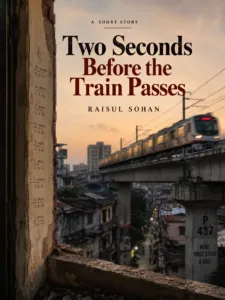
 Those of us who lived in the pondside lane at Kazipara are scattered now across various parts of the city. But if anybody asks where we live, we still name that lane first. Then we catch ourselves and remember that we live in Rupnagar now, or Mirpur Twelve, or Dakkhinkhan. The lane is gone; we are here. And yet we had always supposed that a place outlives the people in it.
The lane was called the pondside lane, though many of us never saw the pond. The elders said it was filled in after the flood of eighty-eight, when the price of earth in the city went up and the price of water went down. The pond was rubbed out; the name stayed. The pond went on living inside the name so successfully that children of the lane, grown up and moved elsewhere, would say, There’s a pond in front of our house. In the city corporation’s books, of course, the lane had another name: Shahid Anwar Road. Who Anwar was, when he was martyred, nobody in our lane could say, and nobody used the name either. So Anwar sahib was lost twice, once in the war and once in our mouths. The habit of standing guard over the names of lost things was one our lane already had; we did not yet know how much more use we would have for it.
First came the men with the yellow instruments. They set the instrument up on three legs and shut one eye and looked at our houses, as though taking aim, and wrote numbers in a register. We gave them tea, they drank the tea and did not stop writing numbers. A few days later red numbers appeared on the walls of the houses. The numbers did not match our holding numbers; they were numbers from some other register, a register we never laid eyes on, and in which our future had already been written.
Then came the notices, and the compensation files. Once it had gone inside a file, our lane got itself tangled in knots that had nothing to do with brick or cement. The three Sardar brothers went to law over the settlement deed. In the Kuddus family’s deed the land was recorded in kathas; the office wanted it in decimal fractions. Between those two systems of measurement, one corner of their yard vanished so completely that it might never have existed. And the business of Nurjahan Manzil was the strangest of all. The deed of the house was in the name of Riazuddin the schoolmaster; the master had been dead twenty-five years; a succession certificate was needed, a death certificate was needed. The death certificate, when it was got out, spelled the name Reyazuddin. So on paper it stood that the man who built the house had not died, and the man who had died did not own the house. To untangle this the master’s grandson Faisal had to go to the office seventeen times. On the seventeenth the thing was done; how it was done he never told us, and we never asked.
Before the demolition the lane emptied by stages. In those months of emptying we came to understand that a neighbourhood does not break in a day; it breaks by breaking. The tenants went first; there was no question of compensation for them, no need of a notice either, they simply called a truck and were gone. Some of them did not even say goodbye, because what is there to say goodbye to in a neighbourhood that will not itself remain. Those of us with deeds in our names got money; those with nothing in their names got nothing. We did not think much about that division at the time; now we think about it sometimes, and say nothing. Then came the scrap dealers. In the last week our doors and windows and grilles and door frames all came off and went onto vans, by the kilo. The doors we had bolted and slept behind all these years went onto the scales and were weighed; the wood fetched a price and the iron fetched a price, and only the habit of bolting them fetched nothing. Those last nights we slept in doorless rooms under mosquito nets, and, strangely, there was no fear of theft then, because everything worth taking had already been sold. On the last Friday there was a prayer at the mosque; we ate the tabarruk afterwards standing up, because by then even the chairs had been sold.
On the day of the demolition many of us stood on the other side of the road. The arm of the excavator first tapped the cornice of the Sardars’ house, as though knocking at a door, and then pulled. The fronts of the houses were taken down to measure, as far as the red line. In the sheer cut faces that were left standing, the insides of our rooms stood facing the road. The green flowered tiles of the first-floor bathroom of the Sardar house could be seen from the street. Two shirts were still hanging on the Kader family’s clothes stand, and for the first few days nobody took them down. On one wall, last year’s calendar; on another, the dark patch a bed head rubs into a wall over forty years. It took the masons about three weeks to brick up the cut faces. For those three weeks the inner houses of our lane lay open in front of everybody on the road. We understood how thin the walls had actually been, and that what we had guarded all these years as the inner house had been two inches of brick away from the street.
Highest of all, in the cut face of the third floor of Nurjahan Manzil, a doorframe was left standing, and on that frame small pencil marks across the grain. Marks of the height of Mansur, the master’s son, from the age of five to thirteen, with the dates beside them. All those years the marks had been inside a room; now they stood facing the open sky, and a little later, when the line opened, they stood at exactly the height of a train window.
Somebody photographed those marks on the doorframe from the train and put it on Facebook. The caption said: Beside the metro rail, a mother’s marks; the son never came back. The photograph was shared twelve thousand times, and thousands of people wrote prayers underneath it, and some of them wept. Those of us who knew that the marks were Mansur’s, and that Riaz master himself had made them, standing his son with his back against the frame on every birthday, wrote nothing in the comments. Even a television channel came; they stood in front of a pillar and told the story of the mother, because by then that story had grown larger than the photograph. They put Saleha Banu in front of the camera; all she said was, Those marks are from my house. That was not broadcast, because you cannot make a story out of a sentence like that.
Riazuddin master built Nurjahan Manzil in seventy-three. In the years after the war the bricks of the broken city were sold cheap; the master bought them by the cartload, and the eastern wall of the house was raised with those bricks, a little darker in colour, and cooler under the hand than the other walls. The red line of the acquisition fell exactly across that wall. So the bricks of nineteen seventy-one were broken a second time, went onto trucks, and where they went we do not know; perhaps they are standing at the other end of the city now as a third wall, carrying their own history themselves.
Who Nurjahan was, Riaz master never told anyone while he lived. Some said it was his mother’s name, some a sister who died young, and among the women of the lane a third version was current which they never once uttered in front of Saleha Banu. Whether Saleha Banu herself ever asked the question in fifty years of marriage, and what answer she got if she did, we do not know. Only, about a year after the house came down, when a girl from an NGO came with a survey form and asked, The house is called Nurjahan Manzil, what relation is Nurjahan to you, Saleha Banu said, I am Nurjahan. The girl wrote it down. Those of us standing there, who knew her name was Saleha, said nothing.
Mansur went to Malaysia in ninety-four, with money from selling land, paid to an agent. For the first two years letters came, then occasional phone calls from a phone shop, then nothing. After ninety-eight we have had no news of him. Saleha Banu used to say, He’s busy. On that one word she got through twenty-two years, and she said it so calmly that not one of us ever found the courage to ask a second question.
But once a year, around Agrahayan, an envelope came addressed to Nurjahan Manzil. In the addressee’s line, Riazuddin master’s name, the full address, down to the holding number, in a running hand; the sender’s line blank. Even after the master died the envelopes did not stop, year after year, the same handwriting, only the letters growing slowly shakier. Whether Saleha Banu opened them, and what she found if she did, we were never able to learn. All Siraj the postman knew was that none of the envelopes was ever returned.
The year after the house came down, a holding tax notice arrived from the city corporation for Nurjahan Manzil. Tax, with arrears, on a house whose front half was by then air. Faisal was angry and said, Tax on a house that doesn’t exist? I’ll go to the office and have the papers corrected. Saleha Banu said, Nothing needs correcting. As long as the tax comes, the house is there. She went to the bank herself, stood in the queue, paid, and kept the receipt in a tin biscuit box where thirty-five years of receipts were kept. From then on the notice came every year, every year she paid, and in the government’s books Nurjahan Manzil went on living, although in the government’s other books the house had by then been acquired and erased. Two truths in two registers; and when asked which we should believe, Saleha Banu would say, The register that takes money doesn’t tell lies.
Through the years between, the construction went over the lane. The piling machine struck the earth day and night, thud, thud, thud, and to the rhythm of those blows the sleep of those of us still living nearby came and went. Men from the office came and glued glass slides across the cracks in our walls; if a crack widened the glass would break, and every morning we got up and looked at the glass, as though taking the house’s temperature. Then the pillars went up, and long girders were set on the heads of the pillars, and the cranes worked all night under yellow lights, and there was dust. In those two years, on our kitchen shelves, on the covers of our Qurans, in the folds of our children’s books, the dust that gathered had the powder of our broken houses mixed into it; we did not think about that then, because thinking about it would have made eating difficult. The day the piling finished, they say many people could not sleep that night; the silence after the noise stopped felt unfamiliar.
And in the back half of the house Saleha Banu’s household had folded itself up so small that the house seemed to have shrunk along with her. The furniture from the front rooms would not fit in the back; the old almirah, finding no place, stood a whole year in a corner of the yard under a polythene sheet, water got into it in the rains and warped the doors, and one day it too went onto a scrap dealer’s van. The cooking moved to the back veranda. In the evenings Saleha Banu would sit on a stool in the yard facing the newly built brick wall, on the other side of which her rooms had once been. She would raise a hand and point: there was the sitting room window, next to it the guest bed, above that Mansur’s room. We saw nothing but a wall; she saw. The plan of the house had settled so deeply inside her body that even now, walking, she would lift her foot at one particular spot where there had been a doorframe, and she would go around the corner of the yard where the pillar’s shadow now falls, because Riaz master’s bed had once stood there, and people do not walk through the place where a bed is.
After the line opened, our new address became a pillar number. To send anything to whatever is left of the broken lane, people now say, behind pillar four hundred and thirty-seven, the tin gate. Nobody invented this new system of addresses; it came of itself with the black stencilled numbers on the pillars. The delivery boys stop their motorcycles and say into the phone, What pillar number did you say; our old men were annoyed at first — a house has a name, doesn’t it! They are not annoyed now, because nobody finds anything by a name any more, and they do find it by a number.
Whatever post comes, Siraj the postman used to leave at Harun’s shop. In the bottom drawer of the shop’s cash box the letters of dead addresses collect: bank letters in the name of a man who is not there; at election time, voter slips for a house that is not there; once, a wedding card for a family that left the lane twenty years ago. Harun does not throw the letters away. Once a year, on the day the shop is cleaned before Ramzan, he pulls out the drawer, takes the letters out, dusts them, puts them back in order by date. Children who come to buy chocolate sometimes ask, Chacha, what’s in the drawer? Harun says, Letters. The children ask, Whose? Harun says, People who exist. The answer is not a lie, and it is not the whole truth either. The post office told Siraj to write on these letters, Addressee’s address does not exist. He did not write it. He used to say, An address isn’t a person, that it should die. On his last day before retirement he was seen walking from the broken head of the lane with an empty bag on his shoulder, touching each pillar as he passed, as though knocking at doors.
Between Kazipara and Shewrapara, when the train goes over our lane, for two seconds you can see the cut faces of the houses out of the left-hand windows. We hear that all sorts of talk about those two seconds has grown up among the regular passengers. Some of them, we hear, look for the Sardars’ staircase, the one that climbs to the third floor and ends in mid-air; some say that seeing the staircase on the morning train means the day will go well, others say it means the opposite, and both parties press their faces to the glass and look for the staircase. On winter mornings, passing through the fog, some passengers say they have seen the whole houses, entire, unbroken, washing hung out at every window. Those who say this are none of them from our lane; so we do not believe it, and we cannot dismiss it either, because it sometimes seems to us that the fog keeps a register of its own, and the acquisition never reached that register.
Sometimes unknown young men and women come, lean against a pillar with the broken staircase behind them, and film themselves on their phones. What song is playing we do not understand, but they take trouble over how they stand, they watch the light and choose their time; the place is beautiful to them. We do not stop them. That broken things are beautiful is their discovery, not ours; to us it is a staircase, the staircase you went up to the roof by, with jars of pickle and dry washing.
And at night somebody is sometimes seen sitting at the top of the Sardars’ staircase. The committee has put a grille at the foot of it, and a lock on the grille, and still somebody sits up there. Some say it is mad Kuddus, who lost his compensation money to his brothers and now wanders from pillar to pillar; some say it is a couple with nowhere else to sit; and some say nothing at all, and only draw their curtains.
About six months after the metro opened, Saleha Banu went to the station one day by herself. She did not understand the ticket machine; the boy at the counter bought her ticket and put it in her hand; going onto the escalator she gripped the rail once, and then went up. That day she went from Shewrapara to Kazipara, came back, went again, came back again — seven times in all. Each time she stood by the left-hand window, and on the way back by the right. The last time, the guard on the platform came over and asked, Chachi, where do you want to get down? She said, I’m not getting down, I’m looking at my house. The boy said nothing more, only handed her up into the next train.
That evening, home again, she told Faisal’s mother, The door of the upstairs room is open. The upstairs room means Mansur’s room, and that room had by then been air for a year and a half. The remark went round among us in whispers for a few days; some said she was old and her eyes were deceiving her; some said at that speed everything is a two-second look, and in two seconds who can tell open from broken; and Nurunnesa’s mother only said, Well, if the door’s open, that’s good, the air gets through. We did not go further than that, because there are some remarks you cannot stand in front of for very long.
Then one winter, at the end of Magh, Saleha Banu died. In her sleep, in the one room of the back half of the house, with the tin biscuit box by her head, and thirty-six years of tax receipts inside the box. The announcement went out on the mosque loudspeaker: a message of mourning, a message of mourning — Nurjahan Begum, wife of the late Riazuddin master of the pondside lane, has passed away. Who gave that name to the loudspeaker — Faisal, or the mosque attendant, or somebody else — we do not know. At first we could not tell who had died; then, hearing the name of the lane, we understood, and having understood, none of us asked anybody anything. Through that announcement she carried the name off with her in the end, as she had carried it off on the NGO’s form, and it seemed to us that when the house is gone a person wraps the name of the house around herself, like a shawl.
The funeral prayer was held under the pillar, in the open ground of the broken lane, where the Sardars’ outer sitting room used to be. Those of us scattered in Rupnagar and Mirpur Twelve and Dakkhinkhan all came back that day; our lane joins itself together now at funerals, and comes apart again when the prayer is over. Standing in the rows we count each other; every time the number is a little smaller. Those we are slow to recognise we recognise by their fathers’ names; the men have changed, the fathers’ names have not. Our children do not come; they do not know the dead, and the lane whose pull would have brought them is the very thing they never had. So by our reckoning the lane has died twice: once at the hands of the excavator, and now slowly, funeral by funeral, person by person. The rows stood east and west, with pillar four hundred and thirty-seven in the middle and rows on either side. Just after the intention was made a train went over our heads; the imam did not stop, only the takbir was pressed under the noise of the train for two seconds and then rose again. Those who looked down out of the train windows in those two seconds saw a funeral; whose funeral, they do not know, as we do not know who they are.
The back half of the house is so narrow that the developers looked at it and went away. In the end a tyre and cylinder shop took it. In the half of the yard that is left, the shiuli tree is still standing; in the shadow of the viaduct it gets no sun now, and still when Ashwin comes it gives flowers, and the flowers drop onto the heap of tyres. The boy at the shop sweeps them away in the morning. It is no fault of his; flowers are not his stock.
The marble plaque that said Nurjahan Manzil, Faisal took away to his flat in Rupnagar. Unable to decide where to fix it, he keeps it under his bed now, wrapped in cloth. One day his younger son pulled it out from under the bed and asked, Abbu, who’s Nurjahan? Faisal said, I don’t know, baba. In that way the question changed hands along with the plaque, and it is our belief that as long as the plaque lasts the question will last, unanswered, as such things do.
Sorting out a tin trunk, Faisal found nine unopened envelopes, in that same running hand, the sender’s line blank. Whether he has opened them we do not know, nor what he found if he did. We have only worked out that from the year the metro opened, the envelopes stopped coming. Why they stopped, who wrote them, why the writing ended — to none of those three questions do we have an answer. One of us said once, Maybe whoever wrote them goes over the top now, on the train. We laughed it off, and ever since we laughed it off the remark has walked about with us.
The year after Saleha Banu died, the tax notice for Nurjahan Manzil came again, with arrears and a penalty. Siraj had retired by then; the new postman, unable to find the address, left the notice at Harun’s shop, in the bottom drawer of the cash box, with the other letters of dead addresses. In the government’s books the house is still there, the tax is falling into arrears, the penalty is growing, and every year that account grows a little larger, as though somebody were measuring height against a doorframe.
The big wall of the cut face was rented last year by a developer company. A huge billboard has gone up on it, with a photograph of a smiling family, and underneath, Your new address is right here. In the darkness between the billboard and the wall we believe Mansur’s height marks are still there; from the train the marks can no longer be seen, only the advertisement.
We ride the metro ourselves now, go to our offices, come home. After Kazipara some of us put our faces to the glass of the left-hand window, and some of us deliberately do not. Two seconds is not very long, and it is not very short either; in two seconds you can take in a billboard, half a yard, shiuli fallen on a heap of tyres, and a staircase climbing into the air. Then the train goes on. Trains stop only at stations, and our lane was never a station.