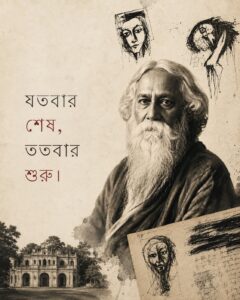
 At the age of thirteen, Rabindranath lost his mother. In My Reminiscences (Jibansmriti), he wrote of that night: “On the night she died, we were asleep. What hour of the night it was I do not know, but an old housemaid rushed into our room, weeping aloud in terror: ‘Oh, what calamity has befallen you children!’ Waking for a fleeting moment in the dim light of a flickering lamp, a sudden sinking fear gripped my chest. Yet I could not truly comprehend what had happened. In the morning, stepping out onto the outer veranda, I saw her adorned body lying upon a bed in the courtyard.”
Nine years later, just four months into Rabindranath’s marriage, Kadambari Devi committed suicide by consuming opium. She was the wife of Jyotirindranath, affectionately called Notun Boutthan by the household. She had been the very first reader of the young Rabindranath’s earliest writings. Rabindranath was only twenty-two. Later, he would write that this bereavement intertwined with every subsequent sorrow of separation, stringing a lengthening garland of tears. And that garland was only to grow longer and longer still.
Everyone knows the myth of the Churning of the Ocean. To obtain amrita—the nectar of immortality—the gods and the asuras churned the great ocean together. The nectar emerged last of all. Before it came halahala, a lethal poison potent enough to extinguish the three worlds. Shiva drank that venom himself, holding it in his throat. His throat turned deep blue, and he came to be known as Neelkantha. To obtain the nectar, someone must first swallow the poison.
In 1901, when the school at Santiniketan was founded, there were no funds. Buildings had to be erected, dormitories built, students fed, teachers paid. Mrinalini Devi sold her jewelry piece by piece. By September of the following year, she fell gravely ill. At first, she was treated for an ordinary ailment. Rathindranath later surmised that it was likely appendicitis. In those days, few even knew the name of the affliction, and surgical techniques had yet to be developed.
Electricity had not yet reached Calcutta. On the first floor of the Lalbari at Jorasanko, Rabindranath sat beside his wife’s bed night after night, fanning her with a hand fan. That was the only remedy within his reach. In the final hours of the night, he called his son and seated him beside his mother’s bed. Rathindranath later wrote: “By then, her speech had ceased. Seeing me, silent streams of tears simply poured from her eyes. That was my last sight of my mother.”
That night, Rabindranath sent all the children to sleep on the second floor of the old house. The children stayed awake through the entire night. While dawn was still wrapped in darkness, they went out to the veranda and gazed toward the Lalbari. In Rathindranath’s words: “The whole house was shrouded in darkness, silent, still. Not a sound or sign of life came from within. We understood right then that our mother was no more.”
It was November 23, 1902. Mrinalini was twenty-nine years old. Their married life had lasted nineteen years. Rabindranath did not sleep that night. Alone upon the rooftop terrace, he paced back and forth all night long. The next morning, handing the pair of slippers his wife wore every day to his son, he said, “Keep these with you. I give them to you.”
During Mrinalini Devi’s illness, their two daughters had also fallen sick. For the middle daughter, Renuka, it began mildly—a slight fever and a nagging cough. It turned out to be tuberculosis. In that era, the disease had no cure.
Rabindranath set out with his ailing daughter. First to Hazaribagh; it brought no relief. Then to Almora, hoping the mountain air might work a miracle. They departed Santiniketan in May 1903. What transpired along the journey, he recounted himself: changing trains at Mughalsarai, arriving in Bareilly twelve hours behind schedule, finding neither lodgings nor porters at Kathgodam. Under the scorching midday sun, starving and cradling his sick daughter in a horse-drawn cart, they finally reached the Ranibagh dawk bungalow where they could at last secure a meal.
In the middle of the letter, he checked himself: “Yet what is to be gained by recounting every hardship of the road?” Almora, too, proved futile. When her condition worsened in August, he returned with her to Calcutta. On the roof terrace of the Lalbari, a glass room was constructed so that sunlight might warm the girl’s frail body. On September 14, 1903, Renuka died. She was twelve years old.
That very day, Rabindranath had sat down for an urgent intellectual discussion. When the meeting concluded, Ramendrasundar Trivedi inquired after his daughter’s health. Rabindranath replied with quiet composure, “She passed away today.” Within two years, in January 1905, his father Debendranath passed away. A proposal was made that year to suspend the Maghotsav celebrations. Rabindranath refused to agree.
To this day, seasonal festivals are celebrated at Santiniketan. When spring arrives, colors take flight, songs resound, and students dance. Rabindranath did not inaugurate this festival. It was initiated by his youngest son, Shamindranath, when Rabindranath was nowhere near. The boy was like his father’s shadow. When down with a fever, he would lie in bed and strike up animated discussions about poetry and music.
During the Puja holidays of 1907, Rabindranath was at a loss as to where to send Shomi. He considered Delhi, then heard that malaria was rampant there. Finally, he wrote to his friend Srish Chandra Majumdar, arranging to send the boy to Munger. In his letter, he wrote: “Shomi does not care for Calcutta, nor does he wish to go there, yet during the holidays Santiniketan feels solitary to him. Shomi occupies so little space and is so unobtrusive that his presence poses no danger to the peace of your town of Munger.” The words of a father. Sending his son to another’s home, a father writes: Do not worry, he takes up so little space.
On October 16, the day of Vijaya Dashami, Shamindranath went to Munger. By mid-November, the dreaded news arrived: cholera. On November 17, Rabindranath boarded the train for Munger accompanied by a doctor. He thought that as soon as the boy improved slightly, he would bring him back to Calcutta. On the night of November 24, Shamindranath died. He was eleven years old.
Rabindranath sat motionless in the adjacent room. Tears rolled down his cheeks without a sound. Exactly five years earlier, in this very month of November, he had lost his wife. What he witnessed the following night, sitting aboard the return train, he recounted years later in a letter to his daughter Mira Devi:
“On the night Shomi departed, I told him with all my soul: let his passage into the vast cosmic existence be unhindered; let not my grief hold him back by even a thread. The night after Shomi left, riding the train, I looked out and saw the sky flooded with moonlight—nowhere was there the slightest sign that anything was lacking. My soul said: nothing is diminished, all remains within the all, and I too am within it.”
Returning after having consigned his young son to the flames, gazing through the train window, this man beheld a sky brimming with moonlight. And he saw that nowhere on this earth had anything been diminished. Eighteen days later, he composed the song: Antara mama bikashita karo antaratora hey—”Unfold my innermost heart, O Thou who art deeper than my depths.”
Eleven years later, on May 16, 1918, his eldest daughter Madhurilata succumbed to tuberculosis at her in-laws’ home, childless, at the age of thirty-one. And in the midst of it all, in 1910, Gitanjali was published.
Listening to the songs of Gitanjali, one might imagine this man lived in untroubled tranquility. He did not. In the very home where Gitanjali was coming to life, death was a perpetual guest. Mother, sister-in-law, wife, two daughters, a son, father. He swallowed the poison, and into our hands, he placed the vessel of nectar.
This is precisely why Rabindrasangeet endures so powerfully. On the days that break you, it is to those songs that you return. Because those songs know sorrow. Not from the outside, but from the marrow within. And the songs of liberation he left behind are not the frivolous jubilation of the fortunate. They are the voice of a man who, having lost everything one by one, looked out through a train window and whispered: Nowhere has anything been diminished.
Today is the twenty-second of Shravan—the anniversary of his passing. Sitting down to listen to his songs on this day, one might remember this: the melody echoing in your ears is a color seen only through the imagination. It was crafted by a man who could not tell red from green, yet who taught us how to see.