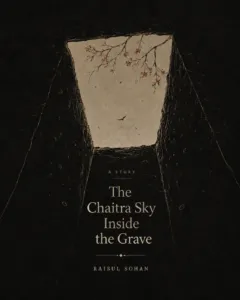
 One dawn in Agrahayan, on his way to bring down the sap from the date palms, Chhoimuddin the tapper sees earth flying up through the fog under the silk-cotton tree in the burial ground. Somebody must have died, he thinks, and goes and stands at the bamboo fence, and sees Montaj Ali sunk to the waist in a half-dug grave. No bier above him, no people, no sound of weeping; only the muffled thud of the spade and the raw wet smell of turned earth. Chhoimuddin lowers his voice and asks, Who’s died, Montaj?
Without lifting his eyes from the earth Montaj says, Nobody’s died.
Chhoimuddin does not ask a second question. He leaves the sap pots where they are and turns back towards the market, and before noon the news has reached every yard in Naldahar: Montaj has taken up the spade.
After that the whole village holds its breath for four days. People go to work, husk paddy, mix feed for the cattle, but all of it with the ears cocked; who is coughing in whose house, how many days has whose fever run — the accounting goes on silently from yard to yard. Osman’s wife Saleha had her fever already, three days old; the kabiraj’s blessed water was being given, the wet cloth was on her forehead. On the fourth day, in the last part of the night, Saleha dies. In the morning, while the women are heating the water for the washing, the men go with their bamboo to the burial ground and find the grave ready. Dry and clean inside, the side niche cut, the loose earth heaped level to one side. Three and a half cubits, to the measure.
It is the measurements that the people of Naldahar discuss in the lowest voices. Because nobody gives Montaj a measurement, nobody ever has. The year tall Afazuddin died, it turned out the grave dug for him beforehand was a span and a half longer than usual, and his legs did not have to be folded; and in the case of thin old Kulsum the grave was so narrow that the young men lowering her could barely get their hands in, yet the old woman went down like a folded paan, without a finger’s width to spare on either side. So nobody in Naldahar asks aloud who a grave is being dug for. They look at the measurements and try to guess, and while they guess they look down at their own bodies.
People also know that when the digging is finished Montaj lies down flat inside the grave once. Whether it is deep enough, whether there is room to lay a body on its side — he measures none of this with a rope, nor with his hand; he measures it with his body. He lies there a while looking up, sees the sky through the gaps in the silk-cotton branches, then stands and beats the earth off himself. Those who have watched this from a distance could not eat their rice when they got home.
For as many days as the grave lies open and waiting, nobody walks past Montaj’s homestead, or if they must, they walk fast. Mothers bring their children in before dusk. If a man gets a fever he hides it, if a cough comes he swallows it; the old men come out into their yards at dawn and walk up and down loudly, as though the neighbourhood needs to be shown, I am here. And yet when a death comes it is to Montaj’s door that they come first of all. They knock at any hour of the night — Montaj bhai, O Montaj bhai. Montaj never refuses, and never delays. For a grave dug in advance he takes no extra money; once when Osman tried to force it into his hand he moved the hand away and said, Dug early or dug late, the earth is neither more nor less.
When the habit began, on that there is no end of talk in Naldahar.
Some say it started the year of the flood. Eleven went that year in the two months of Shrabon and Bhadro; some drowned, some snakebitten, and towards the end three from one household in the cholera. You cannot cut wet earth day after day, and if you cut it you cannot bail it dry; so Montaj used to cut two or three graves ahead of time on the higher, sandier side of the burial ground and cover them with mats to keep the rain out. That year nobody thought anything of it; on the contrary, the families of the dead took his hand and blessed him. Then in Ashwin the water went down, and the habit did not. That is one party’s account, and in that party are the people who like everything in the world to have one straight reason.
Others, the women especially, tell it differently. They say it started with Halima. Halima was Montaj’s wife; strong-built, sparing with words; in the paddy season she too worked on other people’s threshing floors. A fever took her in Kartik and she did not get up from it. The night Halima went, Montaj was sitting at her feet; in the morning, when people came and raised the matter of the grave, he is said to have looked out at the yard and said, Not yet. The sun climbed and he did not get up; in the end it was the neighbours who dug it. A hurried digging; one side crooked, a hump in the bottom, cramped at the head. The night after the burial somebody saw a lamp burning in the burial ground. Going closer, they found Montaj patting the earth of the new grave flat with both hands, the way a mother straightens the quilt over a sleeping child. Ever since then, the women say, Montaj lets no death catch him unprepared. Which is true, the flood or Halima, is argued about now and then and never settled. That both could be true is not something many people in Naldahar will say.
Old Mobarak the muezzin goes back further still. He says the master who taught Montaj to hold a spade, old Daraj the gravedigger, also dug ahead of time in his last years, and in his case too it used to come out right. The other old men will not have it; they say Mobarak has outlived his memory, and now remembers whatever he wants to remember.
Abed the schoolmaster kept a register once. On what date the spade was taken up, on what date the funeral prayer, how many days in between. The register shows one day sometimes, four days sometimes, once nineteen days; and the year mad Hasu drowned in the deep pool, no spade had been taken up at all, Montaj himself being down with fever. The register proves nothing, one way or the other. In the end the master gave up keeping it, though he says at every opportunity, Coincidence, all of it coincidence. Those who hear him nod and say, Yes master, that’s right, and go home and give the door bolt one more pull to make sure.
Not many have had the courage to ask Montaj straight out. Mobarak the muezzin asked him once, sitting on the mosque steps, How do you know, then? Montaj said, I wake up. Another time, to the same question, he said, My palms itch. Another time, after Maghrib, looking out into the dark, for some reason he said, When the earth is lying open-mouthed a man can’t sleep. Which was joking and which was true, Mobarak could not separate, and after that he too stopped asking.
Montaj’s days in Naldahar pass in a certain way. When he goes to buy fish on market day, Nibaran the fishmonger will not take the coins from his hand — Put it on the rack, he says. When he passes in front of the tea stall there is room on the bench, and yet people squeeze together and fill the room up. He has a daughter, married off downriver; she does not come even once a year. Her husband’s family believes the father’s shadow travels with the daughter. Montaj finds fault with nobody. A scrap of homestead behind the rice mill, one hut, a spade hanging on the wall of the hut — with this he lives. He binds the spade himself; when the handle wears out he shaves a branch of the jam tree and fits a new one, and the blade stays the old blade. When he takes it to the smithy to be sharpened, the smith handles the thing very carefully, as if it were hot.
Montaj does not look straight at people. When he speaks he looks at the ground, or at his own hands. There is a reason for this, which he has told nobody. Many years ago, in the press of the market, he suddenly realised that he was running his eye down a stranger from shoulder to heel; the way a sawyer looks over a log before he sets his line. The man was haggling over dried fish in a thin voice, knowing nothing. From that day on, Montaj walks through the market with his eyes down.
Yunus cares for none of this. A boy whose father is dead, whose mother works in other people’s houses; the road to school runs past the burial ground, and Yunus knows the road better than the school. At first he used to watch through the gaps in the fence. Then one day he came inside and dragged the earth basket out of the way, and Montaj said nothing; ever since, he comes now and then, hauls earth, holds the basket, squats at the edge of the grave and asks questions. Montaj will not let him touch the spade. He said to him once, This isn’t a thing you catch hold of, boy. This is a thing that catches you. Yunus did not understand, and Montaj did not explain. When his mother finds out she takes him home by the ear, and two days later the boy is back. So it goes.
At the end of Poush, Montaj takes up the spade again.
This time it is two girls gathering firewood who see him, and before dark the news is round the village as usual. Naldahar holds its breath and waits. But nobody dies.
Seven days pass. Ten. If a man gets a fever he hides it, if a cough comes he buries his face in the pillow; boys stop climbing trees and cross the plank bridge on all fours. Old Rahimuddin had a pain in his chest one night and told nobody in the house, in case the word got out; when the pain eased in the morning he stood in his yard and cleared his throat loudly, so the neighbourhood would hear. There is talk about the measurements too. Some say this one is longer, so a tall person; others say no, middling, but narrow across; and whatever anyone says, the rest first call to mind the build of their own household, then go to bed easy or uneasy. Some go to market the long way round and do not go near the burial ground; and some cannot keep away, and peer through the fence. Empty. The grave lies open-mouthed, sun coming down into it at noon, shade in the afternoon. One night’s rain left a finger of water in the bottom, and Montaj bailed it out at dawn, the way a house is swept and smoothed.
On the twenty-third day Afsar Molla comes into Montaj’s yard with a party behind him. The imam is with him, and Abed the master, and ten others. The imam begins gently; he says, There’s no command in the shariah for digging a grave beforehand, Montaj. The hour of death is knowledge of the unseen. It’s not good to be pulling at that knowledge. Afsar Molla does not go round about; he says, The people of this village can’t sleep. Children won’t go to school. You’ll fill it in by tomorrow.
Montaj looks at the earth of his yard and hears them out. Then he says, All right.
At dawn the next day he goes alone and fills in the grave. He puts the heaped earth back the way it had been stacked, treads it level, spreads a mat over the top, as though nothing had ever been there. Still the place stands a little raised, the way a new grave stands; and there are those whose skin creeps when they look at that raised patch. Whether it is the thought of what is not there, or the thought of what is, they cannot make out.
Then what happens is what nobody in Naldahar expected. Nothing happens.
The month of Magh goes by and nobody dies. It is not that such a month has never come to Naldahar before, but this time the not-dying seems to be a different sort of thing; it seems to be proof. The master raises his voice at the tea stall — Didn’t I tell you? Coincidence. This time, when people say yes, they half mean it in their minds as well. Not everything that is rumoured comes to pass: this plain sentence comes back into the village air, and the air gets lighter.
It is Makbul who calls him first. Montaj was passing in front of the stall, and Makbul put down the kettle and said, Hey, why are you standing there, sit. Montaj sits at the edge of the bench; taking the cup he feels his hand shaking and the tea slopping over, and Makbul pretends not to see and pours him another. After that, on a market day, Nibaran puts the fish straight into his hand and counts the change into his palm, and having done it stands there looking rather astonished at himself. Yunus’s mother stops taking the boy by the ear. Montaj is invited to the naming feast for Rahimuddin’s granddaughter, and goes late and sits in a corner and eats two mouthfuls, and nobody gets up and leaves. He even acquires a place at the stall in the evenings, the east corner of the bench; nobody draws him into the talk, true, but the talk goes on in front of him — the price of paddy, the work on the embankment, whose cow has strayed; and this going-on is a great deal, to Montaj.
Lying down at night, Montaj tries to make the accounts come out. If it is all coincidence, then what has he been carrying all these years; people avoiding him, his daughter not coming, his eyes lowered in the market — then none of it meant anything. The thought does not lighten him. It empties him out, like an empty grave.
One evening the stall was crowded. Makbul was bent over the fire holding the big kettle up high, pouring; in the firelight his neck, the long line of his back; and Montaj realises that he is measuring. Neck to waist, waist to — he drags his eyes down and away, but by then the measurement has been taken, and he knows it. He puts the money on the bench and gets up. Makbul calls after him, Hey, drink your tea. He does not look back. He did not eat that night.
Five days or so later, in the middle of Falgun, in the last part of the night, he wakes.
A weight on his chest like wet earth; that itch in his palms, under the skin, where a nail cannot reach. Outside the fog was coming down, dew dripping on the tin roof. Montaj does not get up. He turns on his side and lies with both hands pressed under his thighs and stays awake until the call to Fajr. The voice is old Mobarak’s; in all these years it has worn down to a thread, and yet in the cold air of the morning that thread pulls taut from one end of the village to the other. Montaj lies and listens, and thinks, today I will do nothing, today I will go nowhere.
Still, at dawn he takes the spade down off the wall. He runs a hand along the handle once, the way a man runs a hand along the neck of an animal he has raised. Then he puts it on his shoulder and goes down to the dead river; the river that runs along the flank of the village, that holds no water except in the rains, only black mud and the dry lines of the hyacinth. He goes down into that mud and buries the spade. Not upright; lengthwise, laid down, the way a body is laid down. He puts mud over it and smooths it with both hands and comes up and does not look behind him. It would be a mistake to think nobody saw. From the top of a date palm Chhoimuddin saw, but he told no one, because he could not decide what he would be telling. A man buries a spade — the sentence means nothing, and because it means nothing it stayed lodged in him like a thorn for a long time.
That day and the two days after, Montaj works on the house. He patches the holes in the roof, changes the ties on the fence, scrapes the grass out of the yard; the jobs that have lain there year after year, because a man with a spade in his hand has no hand free for anything else. At night the weight comes down, the palms burn; he does not get up. If digging makes it happen, then not digging will keep it from happening: this one sentence he holds in both hands, the way a drowning man holds a straw. On the third night the weight comes down so hard that it seems to him somebody is throwing earth onto his chest, one basket, and another; he goes out and stands in the yard, a cut moon in the sky, the grass wet with dew, nothing anywhere. He tells himself, Nothing. He goes in and bolts the door, which he has never in his life done.
On the evening of the fourth day Makbul was putting up the shutters of his stall. Halfway through he crouched down and did not get up again. People carried him inside, threw water on his face, rubbed his chest; before the call to Maghrib it was over.
That same night the sky broke. Rain out of season, and wind with it; even the old men of Naldahar had not seen much water like that in the month of Falgun. When the knock came at Montaj’s door — Montaj bhai, O Montaj bhai — he was already awake. He opens it and there is Osman and three others, sacking over their heads, a hurricane lamp in hand; the light striking their faces from below makes the faces strange. Osman says, Makbul’s gone. Then, looking at Montaj’s empty hands, he says, Where’s your spade?
Gone, Montaj says.
Gone how?
Gone.
There was no time that night for anybody to work out what that meant. Makbul’s father and grandfather lie in the low corner of the burial ground on the river side; by rights his place was there, beside his father. Field spades, crowbars, shovels, whatever was in whose hand — four men go down, and before two strokes are cut it is clear the earth will not listen. Water rises. The wall slumps. Propping one side with split bamboo, bailing with a tin can, they dig, and the rain keeps coming down. Under the mat, on the bier, Makbul lies getting wet. The lamplight shakes. Montaj stood at the edge all night; he passed down the rope, he held the bamboo, he took off his own shawl and spread it over the mat; but he did not go into the pit, and nobody asked him to. He knows the dry ground on the high side, he could have pointed it out with his hand in the dark; but who, that night, would listen to a proposal that a dead man be laid somewhere other than beside his father, and if anyone would have listened, out of whose throat that night could Montaj’s words have come. After Fajr, in the half dark, Makbul is laid down in the mud. The sound of the earth going in is not the dry thudding of other days; it is wet, clinging, as though the earth itself did not want to take him.
On the way back, in the dark, from somewhere in the crowd a low voice says, You knew.
Montaj did not see who said it. It was better that he did not; because afterwards it came to him again and again that the voice could have belonged to anyone at all.
The Naldahar that comes after this is not the Naldahar of before. Before, they were afraid of him because he dug. Now they cannot forgive him because he did not. The shape of the news has changed too; before, it was rumoured that Montaj has taken up the spade; now it is whispered that Montaj has put down the spade, and what lies inside that putting down, what grudge against whom, what old account, nobody says out loud. Makbul’s widow pulls her veil across and turns her face away if she meets him. His brother runs the stall now; the east corner of the bench stays empty, nobody sits there, not Montaj either, Montaj does not go that way any more. Nibaran tells him again to leave the money on the rack; his voice drops a little as he says it, that is all. The master no longer brings up coincidence; once he only said to himself, That register would have been useful now. What use, he does not know himself; the sums come out the same on both sides.
Lying down at night, Montaj cannot get the two accounts to agree. If it is false that digging in advance kills a man, then men die when he does not dig; Makbul died. So he is innocent; so all those years of digging ahead were only earth being moved, nothing more. Up to this point the sum stays straight. But then he remembers the back bent over the kettle in the firelight, and his own eyes taking the measure; and another sum lifts its head, a sum that needs no spade, in which the eyes are enough. Which comes first, the eyes or the death, the death or the eyes. At this place Montaj gets stuck every night, and towards morning it seems to him that what the people of Naldahar do not know, he does not know either; the only difference being that their not knowing lets them sleep and his does not.
In Chaitra the dead river cracks. The black mud dries to a whitish colour, splits into squares, and through the splits you can see the wet dark underneath. One dawn Montaj goes down into the riverbed. Where he buried it, the handle of the spade has risen up, white as a bone. He takes it in both hands and pulls; the dry mud lets go with a crackling. There is rust on the blade, reddish, like an old sore. In one hollow of the riverbed a little muddy water is standing, and he dips the blade in it twice. It does not wash clean, and he knows it; rust does not go with washing, it goes with wearing away.
The silk-cotton is in flower in the burial ground. Red along every branch, and underneath, at intervals, the heavy sound of the fallen flowers, thud, thud, like the strokes of a spade. Montaj goes to the high side and stands, looks over the ground, presses it with his foot, and then cuts.
Yunus comes, skipping school, his book bag on his shoulder. His mother has forbidden it, more strictly now than before; still he climbs the fence. He squats at the edge and watches the earth coming up for a while. Then he asks, Who’s died?
Nobody’s died, Montaj says.
Then who’s it for?
I don’t know, Montaj says, and cuts. Thud. The raw smell of the earth is rising, cold, wet, that old smell, which to the people of Naldahar is fear and to Montaj is only work.
When the digging is done he climbs down inside and lies flat on his back. Above him the branches of the silk-cotton, and through the gaps the white Chaitra sky, and very high up a kite, not calling, only turning. The cold of the earth comes up through his back. Whether it is the cold of comfort or of something else he does not consider; he only lies there, while out of the habit of all these years his body goes on taking the measure by itself — length, width, depth.
A shadow falls across his face from the edge. Yunus is leaning over, blocking out the sky.
Aren’t you getting up? the boy asks.