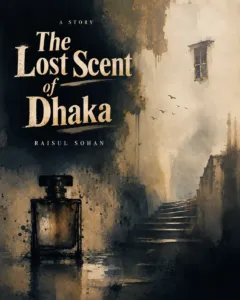
 The lane that burrows inward from the Nazirabazar crossing has Shamsu’s shop right at its mouth. Shop meaning a cubicle four and a half cubits by seven, a glass showcase in front, and bottles arranged inside the showcase. Labels printed with foreign names are pasted on the bottles. The labels change twice a year; what is inside them does not. What is inside, Shamsu makes with his own hands, after eleven at night, with the shutter down, sitting under a sixty-watt yellow bulb. Three kinds of spirit, four kinds of oil, and seven glass droppers. That is his trade. The people who buy know the stuff is not genuine, but they prefer not to remember it, and Shamsu is not fool enough to remind them.
Shamsu’s father sold attar. Here, in this same place, but then there was no showcase; there was a low wooden table with a piece of velvet on it, and eight or so small bottles on the velvet. His father used to say, People buy attar on a Friday and they buy it before they die. Once a week and once in a life. In between those two lie thousands of days, and the smell a man carries on those days is his real smell, and nobody can sell that. After his father died Shamsu gave up attar for perfume, because there is less profit in attar and it takes more patience. But the remark never left his head. It kept coming back, especially at midday, when there is nobody in the lane and the heat comes down the faces of the walls.
Shamsu had an ability nobody else in that quarter had. His nose. With it he read people. Before a customer had come into the shop he would know what the man wanted. A man who smells of mustard oil and starched cloth wants something cheap and also wants a heavy bottle. A man with the smell of one cigarette laid over the smell of another will not ask the price, he will ask the name. And the woman who comes once a month, only smells things and goes away without buying, has the smell of naphthalene in the folds of her sari, which means the sari is not hers, which means she lives in somebody’s house. Shamsu told nobody these things. If he did, people would think him a scoundrel.
He had theories of his own about smell that he could never set out properly. His theory was that the eyes lie, the ears lie more, but the nose does not. Because the nose has no grammar it cannot construct a lie. There is no good or bad in a smell. A smell only opens some old door. What is on the other side, only the owner of the nose knows. That is why people buy perfume. Nobody actually buys perfume for himself; he buys it for the door.
Thinking things like this, eight years went by. He never married; it was always about to happen and never did, and now the family have stopped even discussing whether it will. Shamsu is thirty-four, no belly, hair thinning at the front. He opens the shop at eight in the morning, shuts it at eleven at night, and then sits with his bottles from eleven until half past one. In the middle of the day he eats his rice at Sobed Ali’s eating house inside the lane; the same vegetable, the same dal.
It was on one of those afternoons that the girl first came.
The end of Shrabon, the sky had broken open and rained and stopped, the water was not draining off the street, bubbles were coming up through the gaps in the drain covers. Shamsu was dozing with his elbows on the showcase. A shadow fell across the front of the shop. He did not look up, because he sees with his nose first.
And at that his doze broke.
He does not know this smell. That, to him, is an impossibility. Every smell in this city he has by heart. The smell of wet brick, of dry brick, of mossed brick — three separate things, he knows them. He knows exactly how far the smell of the Badamtoli wholesale market on a Kartik dawn differs from the smell of that same market at midday in Chaitra. And yet no name came into his head for the smell of this girl.
He raised his eyes. A girl of twenty-three or twenty-four, in a sari, nothing much in the colour, nothing much in the face either. Hair stuck damply near her forehead. Nothing in her hands, no bag, no umbrella, and yet not a single splash of mud on her clothes. In this city of mud, to walk here after rain and have no splash on your clothes should not be possible. But Shamsu had no time just then for that sort of arithmetic. His nose was not working, and neither was his head.
He tried to go into the smell, the way he goes into all smells. Underneath there is a heavy layer, old sandalwood, but not real sandalwood — sandalwood that has been handled for many years, a comb or a vermilion box or something of that kind. Over that, naphthalene, but not new naphthalene; naphthalene running out, its sharpness dead and only a suggestion of it left. Over that something sweet, possibly cardamom, or the syrup of preserved fruit. Over that a metallic quality, old brass rings, or tap water that has been sitting in the pipe a long while. And at the very top, most faintly of all, the smell of a person left in old cloth.
So many things cannot exist together. Not in a laboratory, not in nature. Put them together and they should break apart and turn vile. And yet it had not broken. It sat there as though it had always been meant to sit that way.
The girl was leaning over the showcase looking at the bottles. Shamsu cleared his throat.
What shall I show you? Which one?
The girl did not look up. She said, I’ve only come to look. I won’t buy.
What a lovely pull there was in her voice. It sounded like this city, but not like this time. His grandmother’s voice had that pull; his mother’s did not. Shamsu’s arithmetic went wrong again.
He said, Look, then. Looking costs nothing.
The girl picked up three bottles and smelled them. All three times her face went the way it goes when somebody has put salt in your water instead of sugar. In the end she set them down and said, There’s nothing inside these.
Shamsu ought to have lost his temper. He did not. He said, What should be inside?
At this the girl looked at him. Very ordinary eyes, nothing in them, and yet it seemed to Shamsu that it had been a long time since he had properly looked into anybody’s eyes.
The girl said, Whatever was actually there.
Then she went out and into the lane. Shamsu left the showcase open and followed, and stopped short after ten paces, because he saw the lane was empty. A straight lane, sixty-one paces long, Shamsu has counted many times, and no door on either side for the first forty. The girl could not have gone anywhere within ten paces.
But the smell was there. The lane was full of it.
Inside the lane is Hakim Mia’s paan shop. Hakim Mia is over seventy, cataracts in his eyes, sells three hundred taka of paan a day and gets abused by his son’s wife at night. Shamsu saw Hakim Mia sitting with the paan box in front of him. The lime stick in his hand. And water running down both his cheeks. No sound, no twisting of the face, only the water running.
What’s happened, chacha?
Hakim Mia raised a hand to answer and could not. After a long time he said, Badrunnesa.
Shamsu had never heard the name in his life. He asked nothing further, because by then he could see the rest of the lane.
At the first-floor window of house number three, Nawab Ali’s wife was standing with a ladle in her hand, the rice burning on the stove below, the smell of it coming up, and she was not going down. Majid the rickshaw puller, who sits at the foot of the stairs, was sitting with his head down on the seat of his rickshaw; a fare was calling him and he was not answering. Inside Sobed Ali’s eating house two men had been sitting side by side over their rice, and both had stopped, one with his hand on the rice and the other with the mouthful halfway to his mouth. And strangest of all, on the veranda of number four a boy of about ten, to whom nothing has yet happened and to whom nothing ought to have happened, was standing at the railing crying.
From one o’clock to half past, in that half hour, every single person in that lane remembered his first love.
Not everybody wept. Shamsu worked that out afterwards, and it was the thing that troubled him most. Weeping is an easy business. But Afsar sahib, the deed writer of house number seven, that afternoon took his wife by the hair and knocked her against the wall, which in thirty years of marriage he had never done before. Why he did it, he does not know himself. Sobed Ali shut the eating house that night and sat tearing up his account books. And that ten-year-old boy, whose name is Rubel, did not eat for three days.
And what did Shamsu himself remember?
Nothing at all. While everyone within those sixty-one paces was getting back what he had lost, Shamsu stood there working it out with his nose — how much sandalwood, how much naphthalene. He was standing in front of the door of memory, and the door did not open for him.
That night he did not wait for eleven. He brought the shutter down at eight and sat.
At first the job seemed to him very easy. This is exactly what he does. People want a foreign scent; he makes it for them, and nobody can tell. This time he has to make the scent of a lane, that is all. He knows all the materials.
He started with the sandalwood. There is sandalwood oil in the shop, from his father’s time, in a small bottle, which he never touched because the price is out of reach. He took six drops. With it he put vetiver, khaskhas, to bring in the wet-earth quality. Instead of naphthalene he put a little camphor, then thought camphor would not do; camphor is too pious a thing, and there is a dirtiness in naphthalene that camphor has not got. Two drops of cardamom oil. He knew of no oil for the smell of brass. So he left a length of copper wire soaking in spirit all night.
Towards dawn, what he got, when he smelled it, turned his stomach.
The scent had come. Nearly come. So nearly that anybody would smell it and say, Yes, that’s it. But Shamsu knows it is not. The difference lies somewhere he cannot point to and cannot name. There is time mixed into the girl’s smell, which is not in his bottle. The naphthalene in his bottle is the naphthalene in his bottle. But the naphthalene on the girl is old. It is as if some naphthalene ball bought in nineteen seventy-one had lain in a wooden chest for many years.
He did not throw that bottle away. He hid it at the back of the shelf. About a month later a customer smelled it and went suddenly quiet, then bought it for three thousand taka, and on the way out took Shamsu’s hand and said, Brother, don’t make this again. Shamsu did not. He made it that once.
At the beginning of Ashwin, Shamsu began writing from the back of the red account book he keeps for the market. If the search is not organised, a man goes mad; that is his belief. Dates, places, names of people, what people said. On the first page he wrote: 3 Shrabon, Nazirabazar, my lane.
The people of the lanes the girl went into have not forgotten that day. A lock-and-key man in Banshal said to him, Don’t talk to me about that day, brother, that day our whole row went mad. Who went mad? Everybody. Everybody meaning? Everybody meaning everybody. Old Rashid Mia went to Armanitola in a wheelchair after fifty years to look for a house, and the house isn’t there, there’s a seven-storey building where the house was.
Shamsu wrote it down. In about a month there were nine names in the book. Banshal, Agamasi Lane, a lane off Abul Hasnat Road, Malitola, a lane behind Tantibazar that nobody can name, Sutrapur, Narinda, a lane on the river side of Farashganj, and Dayaganj.
The girl does not go into the same lane twice. And in the lane she goes into once, something happens within the following year. That two-storey house on Agamasi Lane, the one with the vine-work on the cornice, came down in Falgun. The pond at Malitola was filled in. A shutter came down at the mouth of the unnamed lane behind Tantibazar; there is a warehouse in there now.
Shamsu could not work out whether the girl comes before or after. Whether she comes because something is going to happen in the lane, or whether these things befall the places only after she has come — he thought about it a great deal. He got no answer. Once he thought, people talk about crows. A crow calls before a man dies. But the crow does not kill the man. So what is it that this girl does?
On an evening in Kartik, at Farashganj, Shamsu caught the smell again.
By then he had been walking about for nearly two months. He leaves Bachchu in the shop and goes out; Bachchu is a boy of fourteen who cannot sell but can sit. Shamsu walks and smells. The wind was coming off the river, and in that wind the smell of jute, and the smell of oil, and the smell of rotting wood. Through all of it, like a thin thread, that smell came again.
The girl was sitting on the steps of a shut timber godown. The same sari. Shamsu stood at a distance, not daring to go closer, and then went closer, because by then fear was no longer working in him.
Do you recognise me?
The girl nodded. I do. You look with your nose.
Shamsu sat down, a little apart. For a long time neither of them spoke. A boat was going down the river with its hurricane lamp swinging.
At last Shamsu said, What’s your name?
What will you do with a name? The girl did not smile, but her voice sounded soft. A name isn’t a smell.
That smell on you, where does it come from?
The girl was silent a long time. Then she said, You ask the wrong thing. What good is knowing where it comes from. Ask where it goes.
Where does it go?
Nowhere. That it goes nowhere, that’s the trouble.
Shamsu did not understand, and then he did. He said, I want to make it.
The girl turned and looked at him then, and it seemed to Shamsu that he was seeing her face for the first time, and yet the next morning when he woke he could not call the face to mind.
The girl said, You sell. You don’t make, you sell. The man who sells never gets his hands on it.
It ought to have sounded like an insult. It did not. It seemed to Shamsu that somebody had drawn an old thorn out of his chest and held it up: look, this has been in here all this time.
They met three more times after that. Three different places, and all three times without warning.
Once at Narinda, at midday, beside the wall of the graveyard. That day Shamsu had brought a white handkerchief with him. While they talked he laid the handkerchief near her shoulder, quite naturally, as though wiping off sweat. The girl said nothing. Shamsu went home and put the handkerchief in a glass jar and sealed the mouth.
Opening the jar at dawn the next day, the smell he got was his mother’s. His mother died nineteen years ago. The smell of rice water, and the smell of hair oil, and the smell inside that room towards the end of her illness. Shamsu sat down on the floor of the shop with the jar in his hands. Bachchu came to raise the shutter and found his ustad sitting on the floor with his cheeks wet.
The second time at Sutrapur. That day he had brought fat with him, goat fat, spread thin on a glass plate. He had read in a book that this is how flower scents are captured, that the French used to do it. He left the plate beside the girl for an hour or so.
Nothing was caught in the fat. Nothing at all. Clean, solid, stupidly white fat.
The third time at Dayaganj. That day he brought nothing. The girl was walking with her hands behind her back, and Shamsu walked beside her. It seemed to him that today there was no need to catch anything.
That afternoon at Dayaganj the girl said something that Shamsu wrote down in the book word for word.
People think a city is bricks and roads. But a city is a smell. Break a brick and there’s still brick, powder, still there. Break a smell and there’s nothing left. Every day, little by little, you are all washing the city off. What are you going to make once you’ve washed it? Have you thought about that?
Shamsu said, I don’t wash anything.
The girl said, What you sell is what people put on after they’ve washed.
By the end of winter the book was full. Twenty-three places. One night Shamsu brought down the shutter and drew a crooked picture of the city on a sheet of paper, and then put a dot at each of the twenty-three places. The dots made no line. No circle either. Shamsu looked at them a long time and understood that they are not a design. Each dot is one place. And what has happened to those places is what he has to find out.
The next week, enquiring at the city corporation, he learned that of the twenty-three, nineteen have already been pulled down, or have received a demolition notice, or have gone onto the list for road widening. Of the remaining four, one is his own lane.
Having got the twenty-three to tally, Shamsu thought that the girl must come before the breaking. To see whether that was right, one morning in Falgun he went to Agamasi Lane. By then the house was gone. A heap of brick, dust, rods, two dogs. He went and sat by the heap, took a piece of broken wall in his hand and held it to his nose.
Nothing.
There is the smell of brick. There is the smell of lime and brick-dust mortar. But the smell of that house is not there. In that house, for eighty years, people cooked rice, children pissed, people died, weddings were held; the caked mark of all of it that ought to be stuck to the walls, that is not there. It has gone off with the dust. It seemed to Shamsu that when a person dies there is a body, there is a grave, there is a name on the grave. When a house dies nothing is left. A house has no corpse.
He stayed kneeling in the dust a long time that morning. Somebody came and asked, Brother, have you lost something? He said, No.
The last time they met was in Chaitra, in his own lane.
That afternoon he was in the shop. He was not dozing as before; he was haggling with a customer who wanted to take an eight-hundred-taka item for six hundred. Then the smell came.
He left the haggling and came out. The girl was standing at the mouth of the lane; she had not come in.
Shamsu said, You’ve been here once already.
The girl said, Yes. Today I’m going.
Shamsu was quiet for a while. Then, for some reason, he said, Why does nothing come back to me? It comes back to everyone else, not to me.
The girl said, Did you have somebody?
Shamsu did not answer. Because he did. Eighteen years ago a girl lived on the first floor of house number five in this lane. Her name he remembers; her face he does not. Her father sold the house and left in nineteen ninety-six. That house is gone too, pulled down, seven storeys now. A mobile phone shop on the ground floor.
The girl said, You haven’t lost it. The place where you put it is gone. If there’s no place at all to keep a thing, where else is it going to be?
Then what do I do.
You don’t have to do anything, the girl said. For the first time Shamsu heard something like tiredness in her voice. The moment a man sets out to do something he wants to put it in a bottle. But once it’s in a bottle it isn’t what it was. After that there’s only the smell of it.
Then she turned and started walking towards the Nazirabazar crossing, in the three o’clock sun, and Shamsu stayed where he was because his feet would not move. At the crossing she turned left and after that could not be seen, but all the way to the crossing the smell lay behind her along the road, like a ribbon, and that ribbon took about ten minutes to fade.
In those ten minutes the lane remembered its first love once more.
Hakim Mia did not weep this time. He shut the paan box and brought down the shutter of his shop. That shutter never went up again. Three weeks later he died. Nawab Ali’s wife did not burn the rice this time. That day she put out the stove and shut the window. Rubel, who was twelve by then, came and stood on the veranda, and then went back inside. At that age boys have learned to hide their crying.
And Shamsu remembered.
He had thought a face would come. That a name would come. Those afternoons of eighteen years ago. But nothing came. Only a smell. The smell of the stairwell of house number five. Damp, slightly sour, the smell of rain on whitewash, and the smell of the pigeons on the cornice. He used to go up those stairs on the pretext of a tuition. The girl would be standing on the first-floor landing. Shamsu would come up, the girl would stand there. That is all he has.
The face did not come. What he has known for eighteen years as memory turns out to be nothing but the smell of a stairwell. The stairwell is gone too. The smell is gone. What he has taken all this time for his own memory was in fact made by that stairwell, its walls, its whitewash, its pigeons and eighteen years, working together.
And nothing much happened after that.
People might imagine that Shamsu gave up the shop, or lost his mind, or went wandering the streets of the city looking for the girl. None of it happened. People do not do those things. Shamsu opened the shop at eight the next morning, had Bachchu wipe the showcase, and sold an eight-hundred-taka perfume for seven hundred to a boy who was buying it to give to a girl.
He has kept the book. Now and then he takes it out and looks. Of the twenty-three names, twenty-two are struck through now instead of nineteen. And at the back of the shelf there is a bottle, empty. He has never put anything in it. Bachchu asked one day, Ustad, why do you keep an empty bottle? Shamsu said, I keep it.
That is all. Though lately this happens sometimes. When a customer stands in front of the showcase and asks, Brother, which is good, which one lasts? Then Shamsu wants to ask, Lasts how long? Do you want it to last till this evening, or do you want somebody thirty years from now to stop halfway up a staircase?
He does not ask. The customer would take fright, and a frightened customer buys nothing. He smiles, pushes forward whichever costs most, and says, Take this one, brother. This one lasts.
Then, when it is time to bring the shutter down, he looks once down the lane. Sixty-one paces, no door on either side for the first forty. The lane is still there. How long it will be there is written in a city corporation file; it is not written in Shamsu’s nose. In this one matter his nose is of no use to him. That is probably why he can sleep at night.